

New 2022 Latest Questions Professional-Machine-Learning-Engineer Dumps - Use Updated Google Exam
Latest Professional-Machine-Learning-Engineer Exam Dumps Google Exam from Training Expert TrainingQuiz
NEW QUESTION 25
You have deployed multiple versions of an image classification model on Al Platform. You want to monitor the performance of the model versions overtime. How should you perform this comparison?
- A. Compare the loss performance for each model on the validation data
- B. Compare the mean average precision across the models using the Continuous Evaluation feature
- C. Compare the loss performance for each model on a held-out dataset.
- D. Compare the receiver operating characteristic (ROC) curve for each model using the What-lf Tool
Answer: A
NEW QUESTION 26
Your data science team needs to rapidly experiment with various features, model architectures, and hyperparameters. They need to track the accuracy metrics for various experiments and use an API to query the metrics over time. What should they use to track and report their experiments while minimizing manual effort?
- A. Use Al Platform Notebooks to execute the experiments. Collect the results in a shared Google Sheets file, and query the results using the Google Sheets API
- B. Use Al Platform Training to execute the experiments Write the accuracy metrics to BigQuery, and query the results using the BigQueryAPI.
- C. Use Al Platform Training to execute the experiments Write the accuracy metrics to Cloud Monitoring, and query the results using the Monitoring API.
- D. Use Kubeflow Pipelines to execute the experiments Export the metrics file, and query the results using the Kubeflow Pipelines API.
Answer: D
NEW QUESTION 27
You are training an LSTM-based model on Al Platform to summarize text using the following job submission script: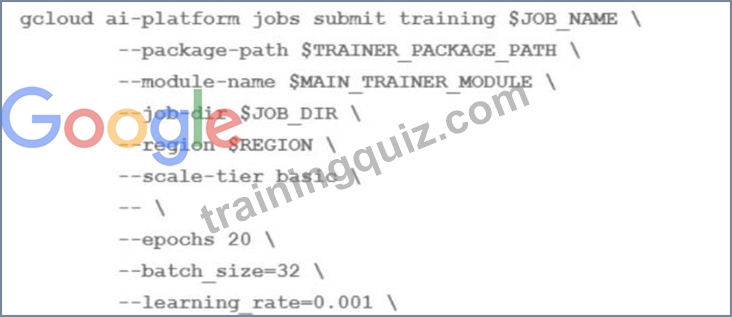
You want to ensure that training time is minimized without significantly compromising the accuracy of your model. What should you do?
- A. Modify the batch size' parameter
- B. Modify the 'scale-tier' parameter
- C. Modify the 'epochs' parameter
- D. Modify the 'learning rate' parameter
Answer: C
NEW QUESTION 28
You are building a linear regression model on BigQuery ML to predict a customer's likelihood of purchasing your company's products. Your model uses a city name variable as a key predictive component. In order to train and serve the model, your data must be organized in columns. You want to prepare your data using the least amount of coding while maintaining the predictable variables. What should you do?
- A. Use Cloud Data Fusion to assign each city to a region labeled as 1, 2, 3, 4, or 5r and then use that number to represent the city in the model.
- B. Use TensorFlow to create a categorical variable with a vocabulary list Create the vocabulary file, and upload it as part of your model to BigQuery ML.
- C. Create a new view with BigQuery that does not include a column with city information
- D. Use Dataprep to transform the state column using a one-hot encoding method, and make each city a column with binary values.
Answer: A
NEW QUESTION 29
You are responsible for building a unified analytics environment across a variety of on-premises data marts. Your company is experiencing data quality and security challenges when integrating data across the servers, caused by the use of a wide range of disconnected tools and temporary solutions. You need a fully managed, cloud-native data integration service that will lower the total cost of work and reduce repetitive work. Some members on your team prefer a codeless interface for building Extract, Transform, Load (ETL) process. Which service should you use?
- A. Dataflow
- B. Apache Flink
- C. Cloud Data Fusion
- D. Dataprep
Answer: C
NEW QUESTION 30
You are an ML engineer at a large grocery retailer with stores in multiple regions. You have been asked to create an inventory prediction model. Your models features include region, location, historical demand, and seasonal popularity. You want the algorithm to learn from new inventory data on a daily basis. Which algorithms should you use to build the model?
- A. Recurrent Neural Networks (RNN)
- B. Convolutional Neural Networks (CNN)
- C. Reinforcement Learning
- D. Classification
Answer: C
NEW QUESTION 31
An agency collects census information within a country to determine healthcare and social program needs by province and city. The census form collects responses for approximately 500 questions from each citizen.
Which combination of algorithms would provide the appropriate insights? (Select TWO.)
- A. The principal component analysis (PCA) algorithm
- B. The Random Cut Forest (RCF) algorithm
- C. The Latent Dirichlet Allocation (LDA) algorithm
- D. The k-means algorithm
- E. The factorization machines (FM) algorithm
Answer: A,D
Explanation:
The PCA and K-means algorithms are useful in collection of data using census form.
NEW QUESTION 32
The displayed graph is from a forecasting model for testing a time series.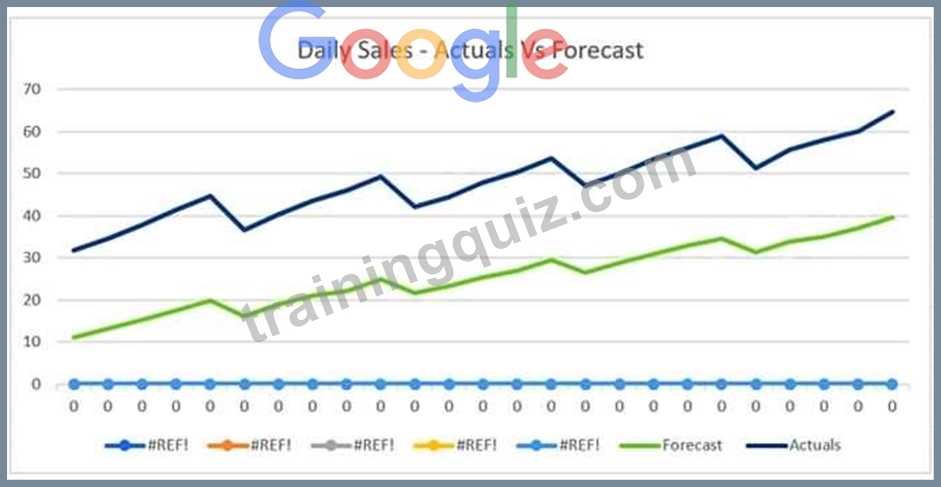
Considering the graph only, which conclusion should a Machine Learning Specialist make about the behavior of the model?
- A. The model does not predict the trend or the seasonality well.
- B. The model predicts the trend well, but not the seasonality.
- C. The model predicts both the trend and the seasonality well
- D. The model predicts the seasonality well, but not the trend.
Answer: A
NEW QUESTION 33
A trucking company is collecting live image data from its fleet of trucks across the globe. The data is growing rapidly and approximately 100 GB of new data is generated every day. The company wants to explore machine learning uses cases while ensuring the data is only accessible to specific IAM users.
Which storage option provides the most processing flexibility and will allow access control with IAM?
- A. Configure Amazon EFS with IAM policies to make the data available to Amazon EC2 instances owned by the IAM users.
- B. Use a database, such as Amazon DynamoDB, to store the images, and set the IAM policies to restrict access to only the desired IAM users.
- C. Use an Amazon S3-backed data lake to store the raw images, and set up the permissions using bucket policies.
- D. Setup up Amazon EMR with Hadoop Distributed File System (HDFS) to store the files, and restrict access to the EMR instances using IAM policies.
Answer: D
Explanation:
Explanation
NEW QUESTION 34
You were asked to investigate failures of a production line component based on sensor readings. After receiving the dataset, you discover that less than 1% of the readings are positive examples representing failure incidents. You have tried to train several classification models, but none of them converge. How should you resolve the class imbalance problem?
- A. Downsample the data with upweighting to create a sample with 10% positive examples
- B. Use the class distribution to generate 10% positive examples
- C. Remove negative examples until the numbers of positive and negative examples are equal
- D. Use a convolutional neural network with max pooling and softmax activation
Answer: C
NEW QUESTION 35
A company is setting up an Amazon SageMaker environment. The corporate data security policy does not allow communication over the internet.
How can the company enable the Amazon SageMaker service without enabling direct internet access to Amazon SageMaker notebook instances?
- A. Create Amazon SageMaker VPC interface endpoints within the corporate VPC.
- B. Create VPC peering with Amazon VPC hosting Amazon SageMaker.
- C. Create a NAT gateway within the corporate VPC.
- D. Route Amazon SageMaker traffic through an on-premises network.
Answer: C
Explanation:
Explanation/Reference: https://docs.aws.amazon.com/sagemaker/latest/dg/sagemaker-dg.pdf (46)
NEW QUESTION 36
Your team is working on an NLP research project to predict political affiliation of authors based on articles they have written. You have a large training dataset that is structured like this:
A)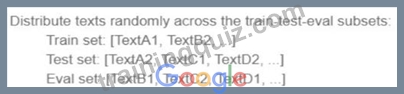
B)
C)
D)
- A. Option C
- B. Option D
- C. Option B
- D. Option A
Answer: A
NEW QUESTION 37
A Machine Learning Specialist has completed a proof of concept for a company using a small data sample, and now the Specialist is ready to implement an end-to-end solution in AWS using Amazon SageMaker. The historical training data is stored in Amazon RDS.
Which approach should the Specialist use for training a model using that data?
- A. Move the data to Amazon DynamoDB and set up a connection to DynamoDB within the notebook to pull data in.
- B. Push the data from Microsoft SQL Server to Amazon S3 using an AWS Data Pipeline and provide the S3 location within the notebook.
- C. Write a direct connection to the SQL database within the notebook and pull data in
- D. Move the data to Amazon ElastiCache using AWS DMS and set up a connection within the notebook to pull data in for fast access.
Answer: B
NEW QUESTION 38
A retail company intends to use machine learning to categorize new products. A labeled dataset of current products was provided to the Data Science team. The dataset includes 1,200 products. The labeled dataset has 15 features for each product such as title dimensions, weight, and price. Each product is labeled as belonging to one of six categories such as books, games, electronics, and movies.
Which model should be used for categorizing new products using the provided dataset for training?
- A. A DeepAR forecasting model based on a recurrent neural network (RNN)
- B. AnXGBoost model where the objective parameter is set to multi:softmax
- C. A regression forest where the number of trees is set equal to the number of product categories
- D. A deep convolutional neural network (CNN) with a softmax activation function for the last layer
Answer: D
NEW QUESTION 39
A Machine Learning Specialist needs to be able to ingest streaming data and store it in Apache Parquet files for exploration and analysis.
Which of the following services would both ingest and store this data in the correct format?
- A. Amazon Kinesis Data Analytics
- B. AWS DMS
- C. Amazon Kinesis Data Firehose
- D. Amazon Kinesis Data Streams
Answer: C
NEW QUESTION 40
You are an ML engineer at a global car manufacturer. You need to build an ML model to predict car sales in different cities around the world. Which features or feature crosses should you use to train city-specific relationships between car type and number of sales?
- A. Three individual features binned latitude, binned longitude, and one-hot encoded car type
- B. One feature obtained as an element-wise product between binned latitude, binned longitude, and one-hot encoded car type
- C. Two feature crosses as a element-wise product the first between binned latitude and one-hot encoded car type, and the second between binned longitude and one-hot encoded car type
- D. One feature obtained as an element-wise product between latitude, longitude, and car type
Answer: B
NEW QUESTION 41
A data scientist uses an Amazon SageMaker notebook instance to conduct data exploration and analysis. This requires certain Python packages that are not natively available on Amazon SageMaker to be installed on the notebook instance.
How can a machine learning specialist ensure that required packages are automatically available on the notebook instance for the data scientist to use?
- A. Use the conda package manager from within the Jupyter notebook console to apply the necessary conda packages to the default kernel of the notebook.
- B. Create a Jupyter notebook file (.ipynb) with cells containing the package installation commands to execute and place the file under the /etc/init directory of each Amazon SageMaker notebook instance.
- C. Install AWS Systems Manager Agent on the underlying Amazon EC2 instance and use Systems Manager Automation to execute the package installation commands.
- D. Create an Amazon SageMaker lifecycle configuration with package installation commands and assign the lifecycle configuration to the notebook instance.
Answer: B
Explanation:
Explanation
Explanation/Reference: https://towardsdatascience.com/automating-aws-sagemaker-notebooks-2dec62bc2c84
NEW QUESTION 42
A manufacturing company has a large set of labeled historical sales data. The manufacturer would like to predict how many units of a particular part should be produced each quarter.
Which machine learning approach should be used to solve this problem?
- A. Logistic regression
- B. Principal component analysis (PCA)
- C. Linear regression
- D. Random Cut Forest (RCF)
Answer: D
NEW QUESTION 43
Your team is building an application for a global bank that will be used by millions of customers. You built a forecasting model that predicts customers1 account balances 3 days in the future. Your team will use the results in a new feature that will notify users when their account balance is likely to drop below $25. How should you serve your predictions?
- A. 1. Create a Pub/Sub topic for each user
2 Deploy a Cloud Function that sends a notification when your model predicts that a user's account balance will drop below the $25 threshold. - B. 1 Build a notification system on Firebase
2. Register each user with a user ID on the Firebase Cloud Messaging server, which sends a notification when your model predicts that a user's account balance will drop below the $25 threshold - C. 1. Build a notification system on Firebase
2. Register each user with a user ID on the Firebase Cloud Messaging server, which sends a notification when the average of all account balance predictions drops below the $25 threshold - D. 1. Create a Pub/Sub topic for each user
2. Deploy an application on the App Engine standard environment that sends a notification when your model predicts that a user's account balance will drop below the $25 threshold
Answer: A
NEW QUESTION 44
A Machine Learning Specialist is working with a large company to leverage machine learning within its products. The company wants to group its customers into categories based on which customers will and will not churn within the next 6 months. The company has labeled the data available to the Specialist.
Which machine learning model type should the Specialist use to accomplish this task?
- A. Clustering
- B. Linear regression
- C. Reinforcement learning
- D. Classification
Answer: D
Explanation:
The goal of classification is to determine to which class or category a data point (customer in our case) belongs to. For classification problems, data scientists would use historical data with predefined target variables AKA labels (churner/non-churner) - answers that need to be predicted - to train an algorithm. With classification, businesses can answer the following questions:
* Will this customer churn or not?
* Will a customer renew their subscription?
* Will a user downgrade a pricing plan?
* Are there any signs of unusual customer behavior?
Reference: https://www.kdnuggets.com/2019/05/churn-prediction-machine-learning.html
NEW QUESTION 45
An online reseller has a large, multi-column dataset with one column missing 30% of its data. A Machine Learning Specialist believes that certain columns in the dataset could be used to reconstruct the missing data.
Which reconstruction approach should the Specialist use to preserve the integrity of the dataset?
- A. Multiple imputation
- B. Listwise deletion
- C. Mean substitution
- D. Last observation carried forward
Answer: A
Explanation:
Explanation/Reference: https://worldwidescience.org/topicpages/i/imputing+missing+values.html
NEW QUESTION 46
You have a functioning end-to-end ML pipeline that involves tuning the hyperparameters of your ML model using Al Platform, and then using the best-tuned parameters for training. Hypertuning is taking longer than expected and is delaying the downstream processes. You want to speed up the tuning job without significantly compromising its effectiveness. Which actions should you take?
Choose 2 answers
- A. Decrease the range of floating-point values
- B. Change the search algorithm from Bayesian search to random search.
- C. Decrease the number of parallel trials
- D. Decrease the maximum number of trials during subsequent training phases.
- E. Set the early stopping parameter to TRUE
Answer: B,D
NEW QUESTION 47
A Machine Learning Specialist is developing a daily ETL workflow containing multiple ETL jobs. The workflow consists of the following processes:
* Start the workflow as soon as data is uploaded to Amazon S3.
* When all the datasets are available in Amazon S3, start an ETL job to join the uploaded datasets with multiple terabyte-sized datasets already stored in Amazon S3.
* Store the results of joining datasets in Amazon S3.
* If one of the jobs fails, send a notification to the Administrator.
Which configuration will meet these requirements?
- A. Use AWS Lambda to trigger an AWS Step Functions workflow to wait for dataset uploads to complete in Amazon S3. Use AWS Glue to join the datasets. Use an Amazon CloudWatch alarm to send an SNS notification to the Administrator in the case of a failure.
- B. Develop the ETL workflow using AWS Batch to trigger the start of ETL jobs when data is uploaded to Amazon S3. Use AWS Glue to join the datasets in Amazon S3. Use an Amazon CloudWatch alarm to send an SNS notification to the Administrator in the case of a failure.
- C. Develop the ETL workflow using AWS Lambda to start an Amazon SageMaker notebook instance. Use a lifecycle configuration script to join the datasets and persist the results in Amazon S3. Use an Amazon CloudWatch alarm to send an SNS notification to the Administrator in the case of a failure.
- D. Use AWS Lambda to chain other Lambda functions to read and join the datasets in Amazon S3 as soon as the data is uploaded to Amazon S3. Use an Amazon CloudWatch alarm to send an SNS notification to the Administrator in the case of a failure.
Answer: A
Explanation:
Explanation/Reference: https://aws.amazon.com/step-functions/use-cases/
NEW QUESTION 48
......
Updated Test Engine to Practice Professional-Machine-Learning-Engineer Dumps & Practice Exam: https://www.trainingquiz.com/Professional-Machine-Learning-Engineer-practice-quiz.html
Pass Google Professional-Machine-Learning-Engineer PDF Dumps Recently Updated 72 Questions: https://drive.google.com/open?id=1pXZQCaElixdGdjhK5xVmbqBKu4bSoIid
