

Updated Apr-2025 Pass PCNSA Exam - Real Practice Test Questions
Download Free Palo Alto Networks PCNSA Real Exam Questions
Palo Alto Networks Certified Network Security Administrator (PCNSA) exam is an excellent way for IT professionals to validate their skills and knowledge in network security administration. Palo Alto Networks Certified Network Security Administrator certification is recognized globally and is ideal for those who work with Palo Alto Networks products and solutions or are planning to do so in the future. The PCNSA exam is a comprehensive certification that covers a wide range of network security topics and is a vendor-neutral exam that does not focus on any specific technology or product.
NEW QUESTION # 170
Which two security profile types can be attached to a security policy? (Choose two.)
- A. DDoS protection
- B. threat
- C. antivirus
- D. vulnerability
Answer: C,D
Explanation:
Explanation/Reference: https://docs.paloaltonetworks.com/pan-os/8-0/pan-os-admin/policy/security-profiles
NEW QUESTION # 171
Match the cyber-attack lifecycle stage to its correct description.
Answer:
Explanation:
NEW QUESTION # 172
Which two features can be used to tag a username so that it is included in a dynamic user group?
(Choose two.)
- A. GlobalProtect agent
- B. User-ID Windows-based agent
- C. XML API
- D. log forwarding auto-tagging
Answer: C,D
Explanation:
Usernames also can be tagged and untagged using the autotagging feature in a Log Forwarding Profile. You also can program another utility to invoke PAN-OS XML API commands to tag or untag usernames. In the web interface you can use logical AND or OR operators with the tags to better filter or match against. You can configure a timeout value that determines when a username will be untagged automatically.
https://www.paloaltonetworks.com/content/dam/pan/en_US/assets/pdf/datasheets/education/pcns e-study-guide.pdf
NEW QUESTION # 173
Match the Palo Alto Networks Security Operating Platform architecture to its description.
Answer:
Explanation:
Explanation:
Threat Intelligence Cloud - Gathers, analyzes, correlates, and disseminates threats to and from the network and endpoints located within the network.
Next-Generation Firewall - Identifies and inspects all traffic to block known threats Advanced Endpoint Protection - Inspects processes and files to prevent known and unknown exploits
NEW QUESTION # 174
With the PAN-OS 11.0 release, which tab becomes newly available within the Vulnerability security profile?
- A. Vulnerability Exceptions
- B. WildFire Inline ML
- C. Advanced Rules
- D. Inline Cloud Analysis
Answer: A
NEW QUESTION # 175
When HTTPS for management and GlobalProtect are enabled on the same interface, which TCP port is used for management access?
- A. 0
- B. 1
- C. 2
- D. 3
Answer: C
Explanation:
https://knowledgebase.paloaltonetworks.com/KCSArticleDetail?id=kA10g000000Cm8SCAS#:~:text=Details,using%20https%20on%20port%204443
NEW QUESTION # 176
What must be configured for the firewall to access multiple authentication profiles for external services to authenticate a non-local account?
- A. authentication list profile
- B. authentication sequence
- C. authentication server list
- D. LDAP server profile
Answer: B
NEW QUESTION # 177
Which service protects cloud-based applications such as Dropbox and Salesforce by administering permissions and scanning files for sensitive information?
- A. GlobalProtect
- B. AutoFocus
- C. Panorama
- D. Aperture
Answer: D
NEW QUESTION # 178
Complete the statement. A security profile can block or allow traffic.
- A. before it is evaluated by a security policy
- B. after it is evaluated by a security policy that allows traffic
- C. after it is evaluated by a security policy that allows or blocks traffic
- D. on unknown-tcp or unknown-udp traffic
Answer: B
Explanation:
Security profiles are not used in the match criteria of a traffic flow. The security profile is applied to scan traffic after the application or category is allowed by the security policy.
NEW QUESTION # 179
An administrator would like to follow the best-practice approach to log the traffic that traverses the firewall.
What action should they take?
- A. Enable Log at Session Start.
- B. Enable both Log at Session Start and Log at Session End.
- C. Enable Log at Session End.
- D. Disable all logging options.
Answer: C
NEW QUESTION # 180
When creating a Panorama administrator type of Device Group and Template Admin, which two things must you create first? (Choose two.)
- A. password profile
- B. server profile
- C. admin rote
- D. access domain
Answer: B,C
NEW QUESTION # 181
Which two statements are correct regarding multiple static default routes when they are configured as shown in the image? (Choose two.)
- A. Route with highest metric is actively used
- B. Path monitoring does not determine if route is useable
- C. Path monitoring determines if route is useable
- D. Route with lowest metric is actively used
Answer: C,D
NEW QUESTION # 182
Match the Cyber-Attack Lifecycle stage to its correct description.
Answer:
Explanation:
Explanation
Reconnaissance - stage where the attacker scans for network vulnerabilities and services that can be exploited.
Installation - stage where the attacker will explore methods such as a root kit to establish persistence Command and Control - stage where the attacker has access to a specific server so they can communicate and pass data to and from infected devices within a network.
Act on the Objective - stage where an attacker has motivation for attacking a network to deface web property
NEW QUESTION # 183
Based on the screenshot presented which column contains the link that when clicked opens a window to display all applications matched to the policy rule?
- A. Apps Seen
- B. Apps Allowed
- C. Service
- D. Name
Answer: D
NEW QUESTION # 184
In which two Security Profiles can an action equal to the block IP feature be configured? (Choose two.)
- A. Antivirus
- B. Vulnerability Protection
- C. Anti-spyware
- D. URL Filtering
Answer: B,C
Explanation:
https://docs.paloaltonetworks.com/pan-os/9-1/pan-os-web-interface-help/objects/objects-security-profiles/actions
NEW QUESTION # 185
What do dynamic user groups you to do?
- A. create a policy that provides auto-remediation for anomalous user behavior and malicious activity
- B. create a policy that provides auto-sizing for anomalous user behavior and malicious activity
- C. create a dynamic list of firewall administrators
- D. create a QoS policy that provides auto-remediation for anomalous user behavior and malicious activity
Answer: A
Explanation:
https://docs.paloaltonetworks.com/pan-os/9-1/pan-os-new-features/user-id-features/dynamic-user-groups#:~:text
NEW QUESTION # 186
Which type of administrator account cannot be used to authenticate user traffic flowing through the firewall's data plane?
- A. local user
- B. Kerberos user
- C. SAML user
- D. local database user
Answer: A
Explanation:
For the other users you can create a auth profile. But for local users (users in XML config), auth profile cannot created.
NEW QUESTION # 187
Which interface type is part of a Layer 3 zone with a Palo Alto Networks firewall?
- A. Aggregate
- B. Management
- C. Aggregation
- D. High Availability
Answer: A
NEW QUESTION # 188
If users from the Trusted zone need to allow traffic to an SFTP server in the DMZ zone, how should a Security policy with App-ID be configured?
- A.

- B.

- C.

- D.
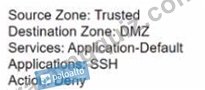
Answer: A
NEW QUESTION # 189
What are the two main reasons a custom application is created? (Choose two.)
- A. To change the default categorization of an application
- B. To reduce unidentified traffic on a network
- C. To correctly identify an internal application in the traffic log
- D. To visually group similar applications
Answer: B,C
Explanation:
https://docs.paloaltonetworks.com/pan-os/11-0/pan-os-admin/app-id/use-application-objects-in-policy/create-a-c
NEW QUESTION # 190
Based on the show security policy rule would match all FTP traffic from the inside zone to the outside zone?
- A. inside-portal
- B. intercone-default
- C. engress outside
- D. internal-inside-dmz
Answer: C
NEW QUESTION # 191
When configuring a security policy, what is a best practice for User-ID?
- A. Limit User-ID to users registered in an Active Directory server.
- B. Use only one method for mapping IP addresses to usernames.
- C. Allow the User-ID agent in zones where agents are not monitoring services.
- D. Deny WMI traffic from the User-ID agent to any external zone.
Answer: D
NEW QUESTION # 192
What is the default metric value of static routes?
- A. 0
- B. 1
- C. 2
- D. 3
Answer: D
NEW QUESTION # 193
How would a Security policy need to be written to allow outbound traffic using Secure Shell (SSH) to destination ports tcp/22 and tcp/4422?
- A. The admin creates a custom service object named "tcp-4422" with port tcp/4422.
The admin also creates a custom service object named "tcp-22" with port tcp/22. - B. The admin creates a Security policy allowing application "ssh" and service "application-default".
- C. The admin creates a custom service object named "tcp-4422" with port tcp/4422.
The admin then creates a Security policy allowing application "ssh", service "tcp-4422". and service "application-default". - D. The admin creates a custom service object named "tcp-4422" with port tcp/4422.
The admin then creates a Security policy allowing application "ssh" and service "tcp-4422".
Answer: A
Explanation:
The admin then creates a Security policy allowing application "ssh", service "tcp-4422". and service "tcp-22".
NEW QUESTION # 194
......
PCNSA Dumps 100 Pass Guarantee With Latest Demo: https://www.trainingquiz.com/PCNSA-practice-quiz.html
Pass Your Exam With 100% Verified PCNSA Exam Questions: https://drive.google.com/open?id=12tuM8o1vtCofDDiSLgBBnFsiPLbYpcr7
