

UPDATED [May 29, 2026] Pass Salesforce Certified MuleSoft Platform Architect I Exam with Latest Questions
MuleSoft-Platform-Architect-I Exam Practice Questions prepared by Salesforce Professionals
NEW QUESTION # 13
When using CloudHub with the Shared Load Balancer, what is managed EXCLUSIVELY by the API implementation (the Mule application) and NOT by Anypoint Platform?
- A. The logging configuration that enables log entries to be visible in Runtime Manager
- B. The number of DNS entries allocated to the API implementation
- C. The SSL certificates used by the API implementation to expose HTTPS endpoints
- D. The assignment of each HTTP request to a particular CloudHub worker
Answer: C
Explanation:
Correct Answer : The SSL certificates used by the API implementation to expose HTTPS endpoints
*****************************************
>> The assignment of each HTTP request to a particular CloudHub worker is taken care by Anypoint Platform itself. We need not manage it explicitly in the API implementation and in fact we CANNOT manage it in the API implementation.
>> The logging configuration that enables log entries to be visible in Runtime Manager is ALWAYS managed in the API implementation and NOT just for SLB. So this is not something we do EXCLUSIVELY when using SLB.
>> We DO NOT manage the number of DNS entries allocated to the API implementation inside the code. Anypoint Platform takes care of this.
It is the SSL certificates used by the API implementation to expose HTTPS endpoints that is to be managed EXCLUSIVELY by the API implementation. Anypoint Platform does NOT do this when using SLBs.
NEW QUESTION # 14
In which layer of API-led connectivity, does the business logic orchestration reside?
- A. Process Layer
- B. Experience Layer
- C. System Layer
Answer: A
Explanation:
Correct Answer : Process Layer
*****************************************
>> Experience layer is dedicated for enrichment of end user experience. This layer is to meet the needs of different API clients/ consumers.
>> System layer is dedicated to APIs which are modular in nature and implement/ expose various individual functionalities of backend systems
>> Process layer is the place where simple or complex business orchestration logic is written by invoking one or many System layer modular APIs So, Process Layer is the right answer.
NEW QUESTION # 15
A large company wants to implement IT infrastructure in its own data center, based on the corporate IT policy requirements that data and metadata reside locally.
Which combination of Mule control plane and Mule runtime plane(s) meets the requirements?
- A. Anypoint Platform Private Cloud Edition for the control plane and customer-hosted Mule runtimes for the runtime plane
- B. The MuleSoft-hosted control plane and customer-hosted Mule runtimes for the runtime plane
- C. Anypoint Platform Private Cloud Edition for the control plane and the MuleSoft-hosted runtime plane
- D. The MuleSoft-hosted control plane and Anypoint Runtime Fabric for the runtime plane
Answer: A
Explanation:
Understanding Control and Runtime Planes:
Control Plane: The control plane is responsible for managing, monitoring, and deploying Mule applications. In a Private Cloud Edition (PCE), this control plane is deployed on-premises within the customer's infrastructure, meeting data residency and security requirements.
Runtime Plane: The runtime plane consists of Mule runtimes that execute Mule applications. By hosting these runtimes within the customer's infrastructure, data and metadata can remain local, which complies with corporate policies regarding data residency.
Evaluating the Options:
Option A: Using Anypoint Platform Private Cloud Edition for the control plane and the MuleSoft-hosted runtime plane would not meet the requirement, as the runtime plane is hosted by MuleSoft and would not keep data local.
Option B: The MuleSoft-hosted control plane with Anypoint Runtime Fabric for the runtime plane would still mean that metadata is managed in MuleSoft's cloud, which does not comply with the requirement to keep data and metadata on-premises.
Option C: A MuleSoft-hosted control plane and customer-hosted Mule runtimes also mean that metadata resides in the cloud, not on-premises, failing the residency requirement.
Option D (Correct Answer): Anypoint Platform Private Cloud Edition (PCE) for the control plane and customer-hosted Mule runtimes fulfill both requirements, as both the control plane and runtime plane would be hosted within the customer's data center.
Conclusion:
Option D is the correct answer, as it ensures that both the control plane and runtime plane are hosted on-premises, allowing data and metadata to reside locally per the corporate IT policy.
Refer to MuleSoft's documentation on Private Cloud Edition deployment and on-premise runtime configurations for further details.
NEW QUESTION # 16
Refer to the exhibit.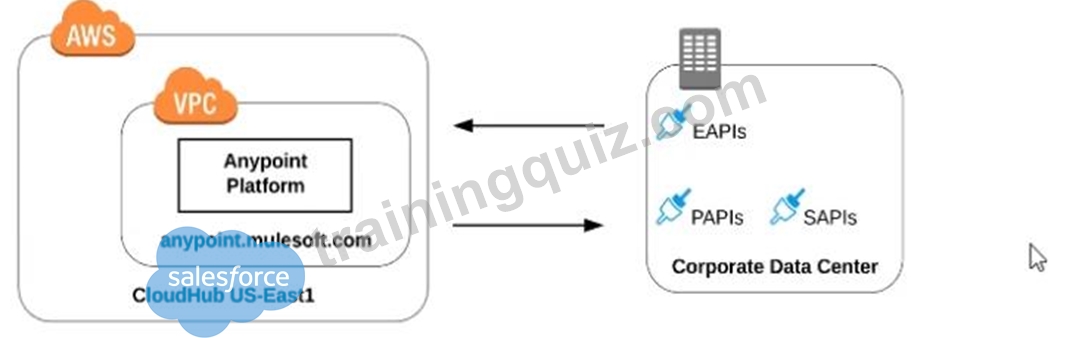
what is true when using customer-hosted Mule runtimes with the MuleSoft-hosted Anypoint Platform control plane (hybrid deployment)?
- A. API implementations can run successfully in customer-hosted Mule runtimes, even when they are unable to communicate with the control plane
- B. The MuleSoft-hosted Shared Load Balancer can be used to load balance API invocations to the Mule runtimes
- C. Anypoint Runtime Manager automatically ensures HA in the control plane by creating a new Mule runtime instance in case of a node failure
- D. Anypoint Runtime Manager initiates a network connection to a Mule runtime in order to deploy Mule applications
Answer: A
Explanation:
Correct Answer : API implementations can run successfully in customer-hosted Mule runtimes, even when they are unable to communicate with the control plane.
*****************************************
>> We CANNOT use Shared Load balancer to load balance APIs on customer hosted runtimes
>> For Hybrid deployment models, the on-premises are first connected to Runtime Manager using Runtime Manager agent. So, the connection is initiated first from On-premises to Runtime Manager. Then all control can be done from Runtime Manager.
>> Anypoint Runtime Manager CANNOT ensure automatic HA. Clusters/Server Groups etc should be configured before hand.
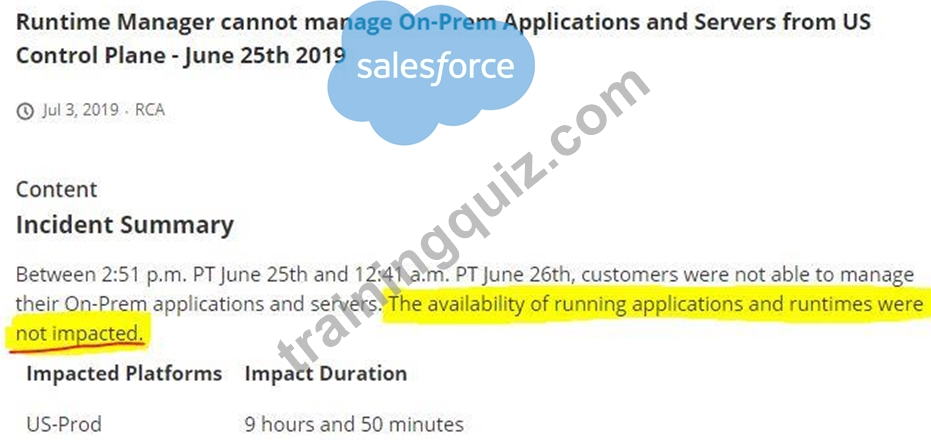
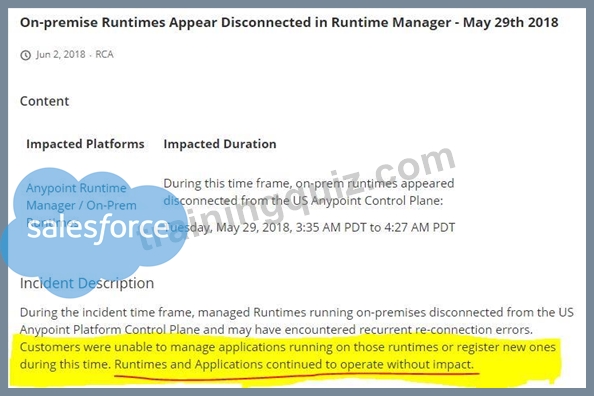
Only TRUE statement in the given choices is, API implementations can run successfully in customer-hosted Mule runtimes, even when they are unable to communicate with the control plane. There are several references below to justify this statement.
Reference:
https://docs.mulesoft.com/runtime-manager/deployment-strategies#hybrid-deployments
https://help.mulesoft.com/s/article/On-Premise-Runtimes-Disconnected-From-US-Control-Plane-June-18th-2018
https://help.mulesoft.com/s/article/Runtime-Manager-cannot-manage-On-Prem-Applications-and-Servers-from-US-Control-Plane-June-25th-2019
https://help.mulesoft.com/s/article/On-premise-Runtimes-Appear-Disconnected-in-Runtime-Manager-May-29th-2018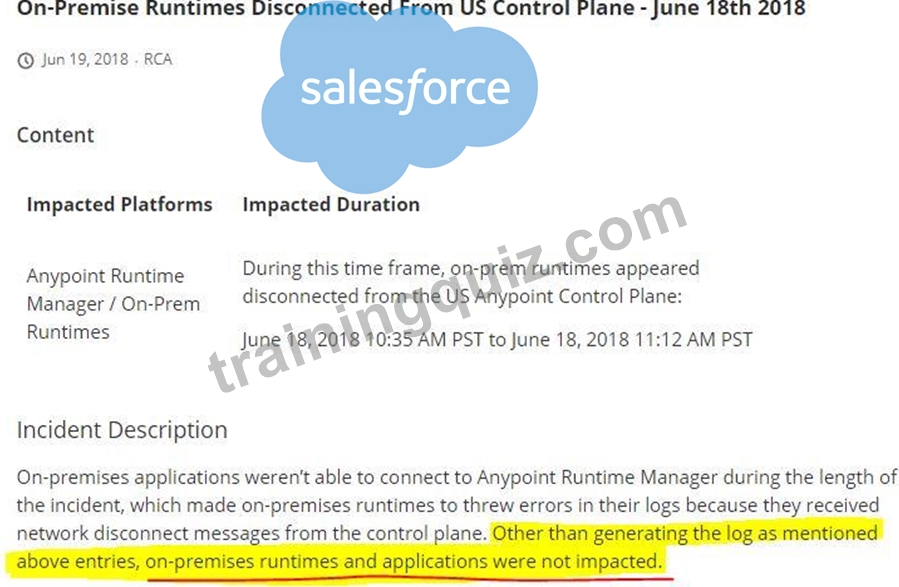
NEW QUESTION # 17
A company uses a hybrid Anypoint Platform deployment model that combines the EU control plane with customer-hosted Mule runtimes. After successfully testing a Mule API implementation in the Staging environment, the Mule API implementation is set with environment-specific properties and must be promoted to the Production environment. What is a way that MuleSoft recommends to configure the Mule API implementation and automate its promotion to the Production environment?
- A. Bundle properties files for each environment into the Mule API implementation's deployable archive, then promote the Mule API implementation to the Production environment using Anypoint CLI or the Anypoint Platform REST APIsB.
- B. Modify the Mule API implementation's properties in Anypoint Exchange, then promote the Mule API implementation to the Production environment using Runtime Manager
- C. Modify the Mule API implementation's properties in the API Manager Properties tab, then promote the Mule API implementation to the Production environment using API Manager
- D. Use an API policy to change properties in the Mule API implementation deployed to the Staging environment and another API policy to deploy the Mule API implementation to the Production environment
Answer: A
NEW QUESTION # 18
How can the application of a rate limiting API policy be accurately reflected in the RAML definition of an API?
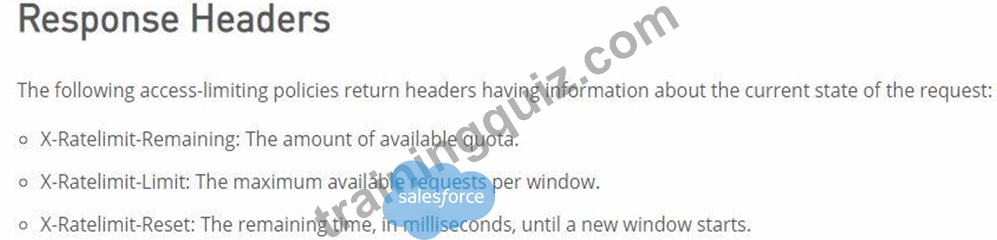
- A. By refining the response definitions by adding the x-ratelimit-* response headers with description, type, and example
- B. By refining the response definitions by adding the out-of-the-box Anypoint Platform rate-limit-enforcement securityScheme with description, type, and example
- C. By refining the request definitions by adding a remaining Requests query parameter with description, type, and example
- D. By refining the resource definitions by adding a description of the rate limiting policy behavior
Answer: A
Explanation:
Correct Answer : By refining the response definitions by adding the x-ratelimit-* response headers with description, type, and example
*****************************************
Reference:
https://docs.mulesoft.com/api-manager/2.x/rate-limiting-and-throttling#response-headers
https://docs.mulesoft.com/api-manager/2.x/rate-limiting-and-throttling-sla-based-policies#response-headers
NEW QUESTION # 19
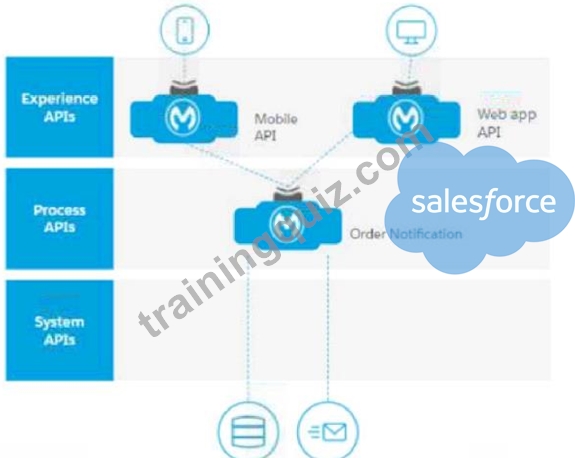
The Line of Business (LoB) of an eCommerce company is requesting a process that sends automated notifications via email every time a new order is processed through the customer's mobile application or through the internal company's web application. In the future, multiple notification channels may be added: for example, text messages and push notifications.
What is the most effective API-led connectivity approach for the scenario described above?
- A. Create one Experience API for the web application and one for the mobile application, Create a Process API to orchestrate, retrieve the email template from a database, and send the email using the Anypoint Connector for Email.
- B. Create Experience APIs for both the web application and mobile application.
Create a Process API ta orchestrate, retrieve the email template from e database, and send the email using the Anypoint Connector for Email.
\ - C. Create one Experience API for the web application and one for the mobile application.
Create a Process API to orchestrate and retrieve the email template from = database.
Create a System API that sends the email using the Anypoint Connector for Email.
Create one Experience API for the web application and one for the mobile application.
Create a Process API to orchestrate and retrieve the email template from = database.
Create a System API that sends the email using the Anypoint Connector for Email. - D. Create Experience APIs for both the web application and mobile application.
(Create 3 Process API to orchestrate and retrieve the email template from 2 databese.
Create a System API that sends the email using the Anypoint Connector for Email.
Answer: C
Explanation:
In this scenario, the best approach to satisfy the API-led connectivity principles and support future scalability is:
Experience APIs:
Create separate Experience APIs for the web application and the mobile application. This allows each application to have an optimized interface, supporting different needs and potential differences in request/response structures or security configurations.
Process API:
A single Process API can be used to orchestrate the workflow, including retrieving the email template from a database and preparing the email content. By centralizing this logic in the Process layer, we can ensure it is reusable and easily adaptable for different notification channels in the future.
System API:
A System API specifically designed for sending emails (using the Anypoint Connector for Email) abstracts the email-sending functionality from the business logic. This approach ensures that the email-sending function is reusable and scalable, and it can easily be extended or modified if other notification channels (like SMS or push notifications) are added later.
Why Option A is Correct:
This structure aligns with API-led connectivity principles by separating concerns across Experience, Process, and System layers. It provides flexibility for future notification channels and isolates each layer's responsibility, making it easier to maintain and scale.
of Incorrect Options:
Option B lacks a separate System API for sending emails, which goes against the principle of isolating back-end functionality in System APIs.
Option C similarly lacks a dedicated System API, reducing flexibility and reusability.
Option D suggests creating multiple Process APIs for database retrieval, which adds unnecessary complexity and does not adhere to the single-orchestration principle typically followed in API-led design.
Reference
For further guidance on API-led connectivity and the responsibilities of each API layer, refer to MuleSoft's documentation on API-led architecture and design best practices.
NEW QUESTION # 20
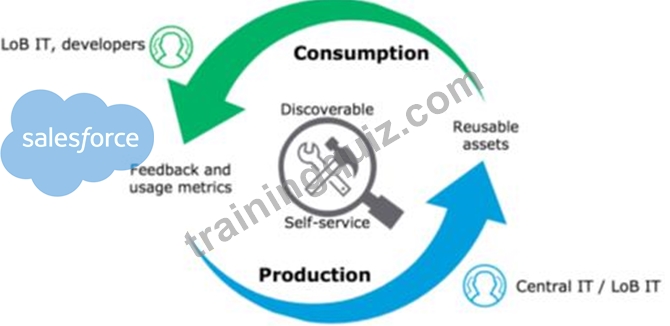
Which of the below, when used together, makes the IT Operational Model effective?
- A. Create resuable assets, make them discoverable so that LOB teams can self-serve and browse the APIs
- B. Create reusable assets, Make them discoverable so that LOB teams can self-serve and browse the APIs, Get active feedback and usage metrics
- C. Create reusable assets, Do marketing on the created assets across organization, Arrange time to time LOB reviews to ensure assets are being consumed or not
Answer: A
Explanation:
Correct Answer : Create reusable assets, Make them discoverable so that LOB teams can self-serve and browse the APIs, Get active feedback and usage metrics.
*****************************************
NEW QUESTION # 21
When can CloudHub Object Store v2 be used?
- A. To store payloads with an average size greater than 15MB
- B. To store information in Mule 4 Object Store v1
- C. To store key-value pairs with keys up to 300 characters
- D. To store an unlimited number of key-value pairs
Answer: C
Explanation:
CloudHub Object Store v2 is a managed key-value store provided by MuleSoft to support various use cases where temporary data storage is required. Here's why Option D is correct:
Key Length Support: Object Store v2 allows storage of keys with a length of up to 300 characters, making it suitable for applications needing flexible and descriptive keys.
Limitations on Size:
Object Store v2 is not intended for large payload storage and has a recommended size limit below 10 MB for each value. Payloads exceeding 15 MB may cause performance issues and are better suited to a file storage system or database.
Option B is incorrect because storing payloads above 15 MB exceeds Object Store's optimal usage specifications.
Key-Value Limits: Object Store v2 is designed for moderate, transient storage needs, and does not support unlimited storage. Thus, Option A is incorrect.
Backward Compatibility: Object Store v2 does not support Mule 4 applications running Object Store v1. Option C is incorrect as Object Store v1 and v2 are distinct.
Reference
For more on CloudHub Object Store v2, refer to MuleSoft documentation on Object Store limitations and configuration.
NEW QUESTION # 22
What is true about where an API policy is defined in Anypoint Platform and how it is then applied to API instances?
- A. The API policy Is defined In API Manager for a specific API Instance, and then ONLY applied to the specific API instance
- B. The API policy is defined in API Manager, and then applied to ALL API instances in the specified environment
- C. The API policy Is defined in API Manager and then automatically applied to ALL API instances
- D. The API policy Is defined In Runtime Manager as part of the API deployment to a Mule runtime, and then ONLY applied to the specific API Instance
Answer: A
Explanation:
Correct Answer : The API policy is defined in API Manager for a specific API instance, and then ONLY applied to the specific API instance.
*****************************************
>> Once our API specifications are ready and published to Exchange, we need to visit API Manager and register an API instance for each API.
>> API Manager is the place where management of API aspects takes place like addressing NFRs by enforcing policies on them.
>> We can create multiple instances for a same API and manage them differently for different purposes.
>> One instance can have a set of API policies applied and another instance of same API can have different set of policies applied for some other purpose.
>> These APIs and their instances are defined PER environment basis. So, one need to manage them seperately in each environment.
>> We can ensure that same configuration of API instances (SLAs, Policies etc..) gets promoted when promoting to higher environments using platform feature. But this is optional only. Still one can change them per environment basis if they have to.
>> Runtime Manager is the place to manage API Implementations and their Mule Runtimes but NOT APIs itself. Though API policies gets executed in Mule Runtimes, We CANNOT enforce API policies in Runtime Manager. We would need to do that via API Manager only for a cherry picked instance in an environment.
So, based on these facts, right statement in the given choices is - "The API policy is defined in API Manager for a specific API instance, and then ONLY applied to the specific API instance".
NEW QUESTION # 23
What API policy would be LEAST LIKELY used when designing an Experience API that is intended to work with a consumer mobile phone or tablet application?
- A. JSON threat protection
- B. IPwhitellst
- C. OAuth 2.0 access token enforcement
- D. Client ID enforcement
Answer: B
Explanation:
Correct Answer : IP whitelist
*****************************************
>> OAuth 2.0 access token and Client ID enforcement policies are VERY common to apply on Experience APIs as API consumers need to register and access the APIs using one of these mechanisms
>> JSON threat protection is also VERY common policy to apply on Experience APIs to prevent bad or suspicious payloads hitting the API implementations.
>> IP whitelisting policy is usually very common in Process and System APIs to only whitelist the IP range inside the local VPC. But also applied occassionally on some experience APIs where the End User/ API Consumers are FIXED.
>> When we know the API consumers upfront who are going to access certain Experience APIs, then we can request for static IPs from such consumers and whitelist them to prevent anyone else hitting the API.
However, the experience API given in the question/ scenario is intended to work with a consumer mobile phone or tablet application. Which means, there is no way we can know all possible IPs that are to be whitelisted as mobile phones and tablets can so many in number and any device in the city/state/country/globe.
So, It is very LEAST LIKELY to apply IP Whitelisting on such Experience APIs whose consumers are typically Mobile Phones or Tablets.
NEW QUESTION # 24
Due to a limitation in the backend system, a system API can only handle up to 500 requests per second. What is the best type of API policy to apply to the system API to avoid overloading the backend system?
- A. Rate limiting
- B. Spike control
- C. Rate limiting - SLA based
- D. HTTP caching
Answer: B
Explanation:
Correct Answer : Spike control
*****************************************
>> First things first, HTTP Caching policy is for purposes different than avoiding the backend system from overloading. So this is OUT.
>> Rate Limiting and Throttling/ Spike Control policies are designed to limit API access, but have different intentions.
>> Rate limiting protects an API by applying a hard limit on its access.
>> Throttling/ Spike Control shapes API access by smoothing spikes in traffic.
That is why, Spike Control is the right option.
NEW QUESTION # 25
Refer to the exhibit.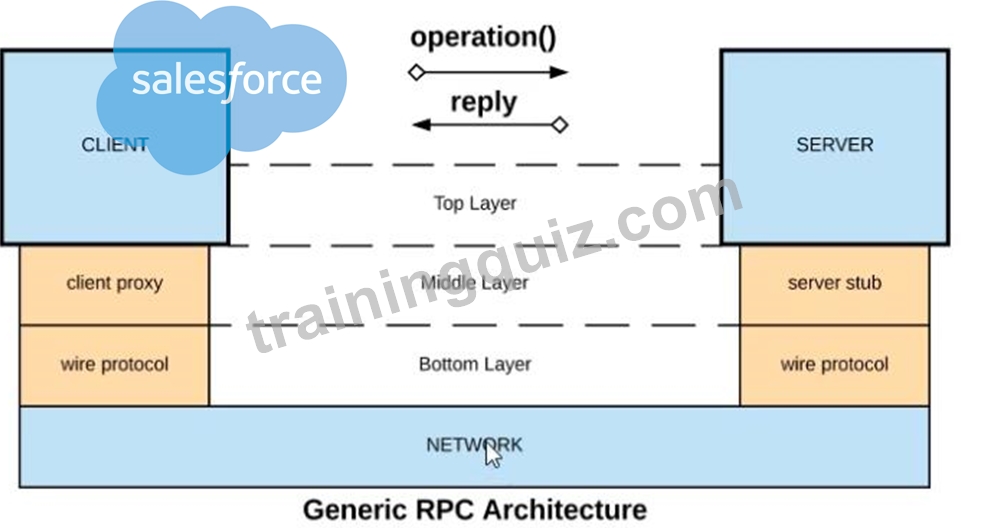
What is a valid API in the sense of API-led connectivity and application networks?
A) Java RMI over TCP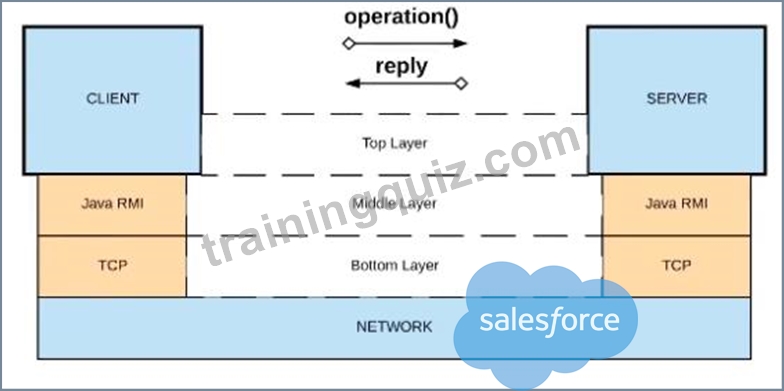
B) Java RMI over TCP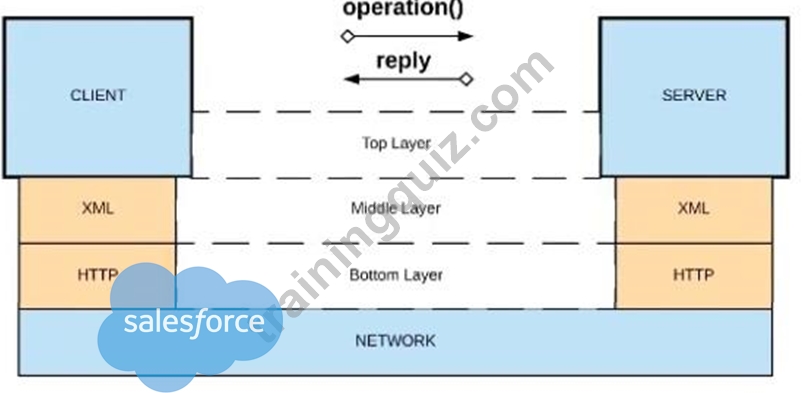
C) CORBA over HOP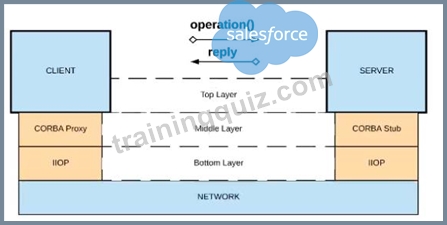
D) XML over UDP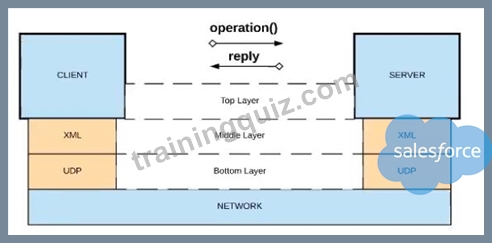
- A. Option D
- B. Option C
- C. Option B
- D. Option A
Answer: A
Explanation:
Correct Answer : XML over HTTP
*****************************************
>> API-led connectivity and Application Networks urge to have the APIs on HTTP based protocols for building most effective APIs and networks on top of them.
>> The HTTP based APIs allow the platform to apply various varities of policies to address many NFRs
>> The HTTP based APIs also allow to implement many standard and effective implementation patterns that adhere to HTTP based w3c rules.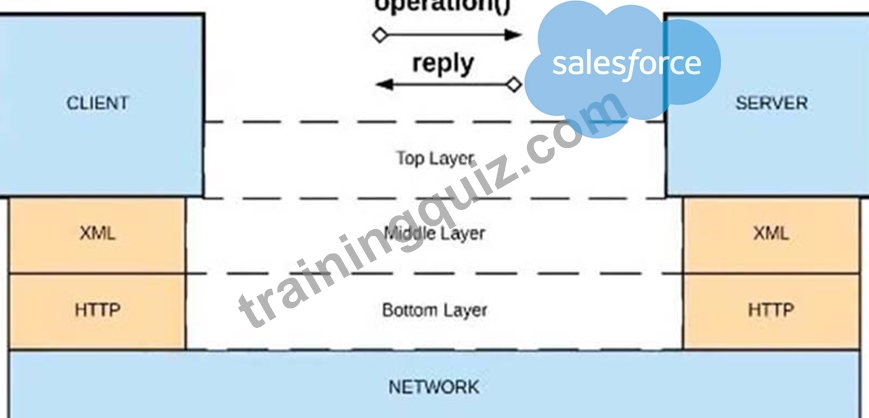
Bottom of Form
Top of Form
NEW QUESTION # 26
Question 10: Skipped
An API implementation returns three X-RateLimit-* HTTP response headers to a requesting API client. What type of information do these response headers indicate to the API client?
- A. The remaining capacity allowed by the API implementation
- B. The HTTP response size
- C. A correlation ID that should be sent in the next request
- D. The error codes that result from throttling
Answer: A
Explanation:
Correct Answe r: The remaining capacity allowed by the API implementation.
*****************************************
>> Reference: https://docs.mulesoft.com/api-manager/2.x/rate-limiting-and-throttling-sla-based-policies#response-headers
NEW QUESTION # 27
Select the correct Owner-Layer combinations from below options
- A. 1. App Developers owns and focuses on Experience Layer APIs
2. Central IT owns and focuses on Process Layer APIs
3. LOB IT owns and focuses on System Layer APIs - B. 1. Central IT owns and focuses on Experience Layer APIs
2. LOB IT owns and focuses on Process Layer APIs
3. App Developers owns and focuses on System Layer APIs - C. 1. App Developers owns and focuses on Experience Layer APIs
2. LOB IT owns and focuses on Process Layer APIs
3. Central IT owns and focuses on System Layer APIs
Answer: C
Explanation:
Correct Answer :
1. App Developers owns and focuses on Experience Layer APIs
2. LOB IT owns and focuses on Process Layer APIs
3. Central IT owns and focuses on System Layer APIs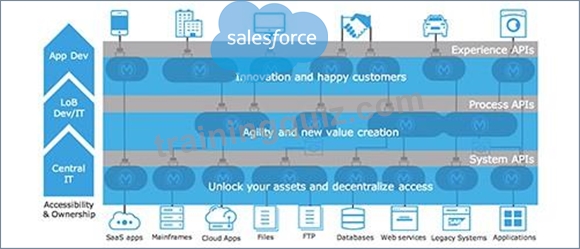
Reference:
https://blogs.mulesoft.com/biz/api/experience-api-ownership/
https://blogs.mulesoft.com/biz/api/process-api-ownership/
https://blogs.mulesoft.com/biz/api/system-api-ownership/
NEW QUESTION # 28
An API is protected with a Client ID Enforcement policy and uses the default configuration. Access is requested for the client application to the API, and an approved contract now exists between the client application and the API How can a consumer of this API avoid a 401 error "Unauthorized or invalid client application credentials"?
- A. Send the obtained clent_id and clent_secret as URI parameters in every call
- B. Send the obtained: client_id and client_secret in the request body
- C. Send the obtained clent_id and client_secret in the header of every API Request call
- D. Send the obtained token as a header in every call
Answer: A
Explanation:
When using the Client ID Enforcement policy with default settings, MuleSoft expects the client_id and client_secret to be provided in the URI parameters of each request. This policy is typically used to control and monitor access by validating that each request has valid credentials. Here's how to avoid a 401 Unauthorized error:
URI Parameters Requirement:
The default configuration for the Client ID Enforcement policy requires the client_id and client_secret to be included in each request's URI parameters. This is a straightforward way to authenticate API requests without additional configurations.
Why Option C is Correct:
Providing client_id and client_secret in the URI parameters meets the policy's requirements for each request, ensuring authorized access and avoiding the 401 error.
of Incorrect Options:
Option A (sending a token in the header) would be applicable for token-based authentication (like OAuth 2.0), not Client ID Enforcement.
Option B (request body) and Option D (header) are not valid locations for client_id and client_secret under the default configuration of Client ID Enforcement, which expects them in the URI.
Reference
For more details, consult MuleSoft's documentation on Client ID Enforcement policies and expected request configurations
NEW QUESTION # 29
An organization wants to create a Center for Enablement (C4E). The IT director schedules a series of meetings with IT senior managers.
What should be on the agenda of the first meeting?
- A. Specify operating model for the MuleSoft Integrations division
- B. Define C4E objectives, mission statement, guiding principles, a
- C. Explore API monetization options based on identified use cases through MuleSoft
- D. A walk through of common-services best practices for logging, auditing, exception handling, caching, security via policy, and rate limiting/throttling via policy
Answer: B
Explanation:
In the initial meeting for establishing a Center for Enablement (C4E), it's essential to lay the foundational vision, objectives, and guiding principles for the team. Here's why this is crucial:
Clear Vision and Mission:
Defining the mission statement and objectives at the start ensures alignment within the organization and clarifies the C4E's role in supporting API-led development and integration practices.
Guiding Principles:
Establishing guiding principles will help the C4E maintain consistent practices and strategies across projects. This serves as a framework for decisions and fosters shared understanding among IT leaders and stakeholders.
of Correct Answer (A):
By prioritizing the C4E's objectives and mission, the organization builds a solid foundation, paving the way for subsequent meetings focused on technical standards, processes, and operating models.
of Incorrect Options:
Option B (API monetization) and Option C (common services best practices) are specific topics better suited for later discussions.
Option D (specifying the operating model) is an important step but typically follows the establishment of the C4E's objectives and vision.
Reference
For more on C4E objectives and foundational setup, refer to MuleSoft's documentation on establishing a C4E and the roles and mission statements recommended for such initiatives.
NEW QUESTION # 30
Refer to the exhibit.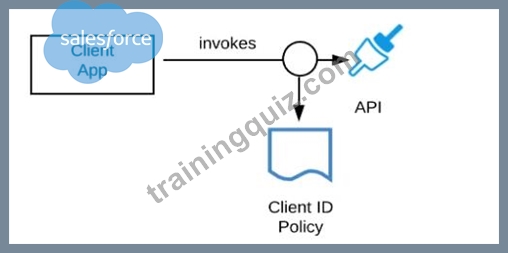
A developer is building a client application to invoke an API deployed to the STAGING environment that is governed by a client ID enforcement policy.
What is required to successfully invoke the API?
- A. A valid OAuth token obtained from Anypoint Platform and its associated client ID and secret
- B. The client ID and secret obtained from Anypoint Exchange for the API instance in the STAGING environment
- C. The client ID and secret for the Anypoint Platform account's STAGING environment
- D. The client ID and secret for the Anypoint Platform account owning the API in the STAGING environment
Answer: B
Explanation:
Correct Answer : The client ID and secret obtained from Anypoint Exchange for the API instance in the STAGING environment
*****************************************
>> We CANNOT use the client ID and secret of Anypoint Platform account or any individual environments for accessing the APIs
>> As the type of policy that is enforced on the API in question is "Client ID Enforcment Policy", OAuth token based access won't work.
Right way to access the API is to use the client ID and secret obtained from Anypoint Exchange for the API instance in a particular environment we want to work on.
Reference:
Managing API instance Contracts on API Manager
https://docs.mulesoft.com/api-manager/1.x/request-access-to-api-task
https://docs.mulesoft.com/exchange/to-request-access
https://docs.mulesoft.com/api-manager/2.x/policy-mule3-client-id-based-policies
NEW QUESTION # 31
A customer wants to host their MuleSoft applications in CloudHub 1.0, and these applications should be available at the domain https://api.acmecorp.com.
After creating a dedicated load balancer (DLB) called acme-dib-prod, which further action must the customer take to complete the configuration?
- A. Configure the DLB with a TLS certificate for api.acmecorp.com and create a CNAME record from api.acmecorp.com to acme-dib-prod.|lb.anypointdns.net
- B. Configure the DLB with a TLS certificate for acme-dib-prod.Jb.anypointdns.net and create a CNAME record from api.acmecorp:com to acme-dlb-prod.lb.anypointdns.net
- C. Configure the DLB with a TLS certificate for api.acmecorp.com and create an A record for api.acmecorp.com to the public IP addresses associated with their DLB
- D. Configure the DLB with a TLS certificate for aplacmecorp.com and create a CNAME record from api.aomecorp.com to acme-dib-prod.ei.cloubhub.io
Answer: A
Explanation:
When setting up a custom domain for MuleSoft applications hosted on CloudHub 1.0 using a Dedicated Load Balancer (DLB), follow these steps:
Set Up the TLS Certificate: Configure the DLB (acme-dib-prod) with a TLS certificate that covers the custom domain api.acmecorp.com. This certificate will allow HTTPS traffic to be securely directed through the DLB to your Mule applications.
DNS Configuration with CNAME:
Create a CNAME record that points api.acmecorp.com to the DLB hostname acme-dib-prod.lb.anypointdns.net.
The CNAME record enables the custom domain to resolve to the DLB provided by MuleSoft's Anypoint Platform. This CNAME mapping directs all traffic to the correct DLB for processing and load distribution.
Why Option B is Correct:
A CNAME record provides the necessary aliasing to acme-dib-prod.lb.anypointdns.net, which is the endpoint managed by Anypoint Platform for your DLB.
Option B also correctly identifies the need to configure the DLB with a TLS certificate specifically for api.acmecorp.com rather than for the DLB's internal hostname.
of Incorrect Options:
Options that suggest configuring the DLB with a TLS certificate for the DLB's internal hostname or using an A record are not suitable in this scenario. MuleSoft CloudHub 1.0 DLBs work with CNAME records to provide flexible and scalable domain management, and a direct IP (A record) is not supported for these load balancers.
Reference
For more information on configuring custom domains and DLBs on CloudHub 1.0, refer to the MuleSoft documentation on DLB setup and DNS configuration.
NEW QUESTION # 32
What best describes the Fully Qualified Domain Names (FQDNs), also known as DNS entries, created when a Mule application is deployed to the CloudHub Shared Worker Cloud?
- A. The FQDNs are determined by both the application name and the Anypoint Platform organization
- B. The FQDNs are determined by the application name, but can be modified by an administrator after deployment
- C. The FQDNs are determined by the application name chosen, IRRESPECTIVE of the region
- D. A fixed number of FQDNs are created, IRRESPECTIVE of the environment and VPC design
Answer: C
Explanation:
Correct Answer : The FQDNs are determined by the application name chosen, IRRESPECTIVE of the region
*****************************************
>> When deploying applications to Shared Worker Cloud, the FQDN are always determined by application name chosen.
>> It does NOT matter what region the app is being deployed to.
>> Although it is fact and true that the generated FQDN will have the region included in it (Ex: exp-salesorder-api.au-s1.cloudhub.io), it does NOT mean that the same name can be used when deploying to another CloudHub region.
>> Application name should be universally unique irrespective of Region and Organization and solely determines the FQDN for Shared Load Balancers.
NEW QUESTION # 33
A code-centric API documentation environment should allow API consumers to investigate and execute API client source code that demonstrates invoking one or more APIs as part of representative scenarios.
What is the most effective way to provide this type of code-centric API documentation environment using Anypoint Platform?
- A. Enable mocking services for each of the relevant APIs and expose them via their Anypoint Exchange entry
- B. Create API Notebooks and include them in the relevant Anypoint Exchange entries
- C. Ensure the APIs are well documented through their Anypoint Exchange entries and API Consoles and share these pages with all API consumers
- D. Make relevant APIs discoverable via an Anypoint Exchange entry
Answer: B
Explanation:
Correct Answe r: Create API Notebooks and Include them in the relevant Anypoint exchange entries
*****************************************
>> API Notebooks are the one on Anypoint Platform that enable us to provide code-centric API documentation Reference:
Bottom of Form
Top of Form
NEW QUESTION # 34
A new upstream API Is being designed to offer an SLA of 500 ms median and 800 ms maximum (99th percentile) response time. The corresponding API implementation needs to sequentially invoke 3 downstream APIs of very similar complexity.
The first of these downstream APIs offers the following SLA for its response time: median: 100 ms, 80th percentile: 500 ms, 95th percentile: 1000 ms.
If possible, how can a timeout be set in the upstream API for the invocation of the first downstream API to meet the new upstream API's desired SLA?
- A. Do not set a timeout; the Invocation of this API Is mandatory and so we must wait until it responds
- B. Set a timeout of 50 ms; this times out more invocations of that API but gives additional room for retries
- C. No timeout is possible to meet the upstream API's desired SLA; a different SLA must be negotiated with the first downstream API or invoke an alternative API
- D. Set a timeout of 100 ms; that leaves 400 ms for the other two downstream APIs to complete
Answer: D
Explanation:
Correct Answer : Set a timeout of 100ms; that leaves 400ms for other two downstream APIs to complete
*****************************************
Key details to take from the given scenario:
>> Upstream API's designed SLA is 500ms (median). Lets ignore maximum SLA response times.
>> This API calls 3 downstream APIs sequentially and all these are of similar complexity.
>> The first downstream API is offering median SLA of 100ms, 80th percentile: 500ms; 95th percentile: 1000ms.
Based on the above details:
>> We can rule out the option which is suggesting to set 50ms timeout. Because, if the median SLA itself being offered is 100ms then most of the calls are going to timeout and time gets wasted in retried them and eventually gets exhausted with all retries. Even if some retries gets successful, the remaining time wont leave enough room for 2nd and 3rd downstream APIs to respond within time.
>> The option suggesting to NOT set a timeout as the invocation of this API is mandatory and so we must wait until it responds is silly. As not setting time out would go against the good implementation pattern and moreover if the first API is not responding within its offered median SLA 100ms then most probably it would either respond in 500ms (80th percentile) or 1000ms (95th percentile). In BOTH cases, getting a successful response from 1st downstream API does NO GOOD because already by this time the Upstream API SLA of 500 ms is breached. There is no time left to call 2nd and 3rd downstream APIs.
>> It is NOT true that no timeout is possible to meet the upstream APIs desired SLA.
As 1st downstream API is offering its median SLA of 100ms, it means MOST of the time we would get the responses within that time. So, setting a timeout of 100ms would be ideal for MOST calls as it leaves enough room of 400ms for remaining 2 downstream API calls.
NEW QUESTION # 35
......
MuleSoft-Platform-Architect-I Exam Practice Materials Collection: https://www.trainingquiz.com/MuleSoft-Platform-Architect-I-practice-quiz.html
Use Valid New MuleSoft-Platform-Architect-I Questions - Top choice Help You Gain Success: https://drive.google.com/open?id=1x5atgJsaelJnEkghI_Wtt-Hgcm4mMMWb
