

[Oct-2021] Pass AZ-104 Exam in First Attempt UpdatedAZ-104 TrainingQuiz Exam Question
Microsoft Azure Administrator Associate Dumps AZ-104 Exam for Full Questions - Exam Study Guide
NEW QUESTION 214
You create a Recovery Services vault backup policy named Policy1 as shown in the following exhibit:

Use the drop-down menus to select the answer choice that completes each statement based on the information presented in the graphic.
NOTE: Each correct selection is worth one point.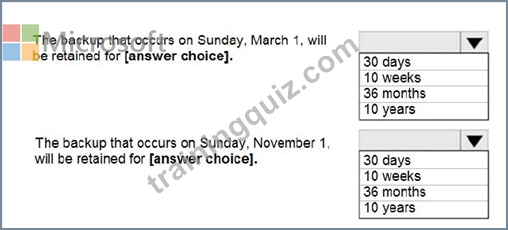
Answer:
Explanation: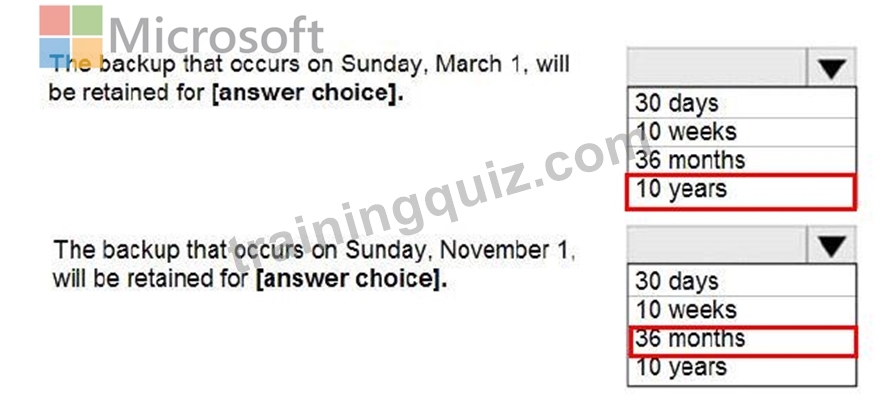
Explanation:
Box 1: 10 years
The yearly backup point occurs to 1 March and its retention period is 10 years.
Box 2: 36 months
The monthly backup point occurs on the 1st of every month and its retention period is 36 months.
NEW QUESTION 215
You have an Azure Active Directory (Azure AD) tenant that contains three global administrators named Admin1, Admin2, and Admin3.
The tenant is associated to an Azure subscription. Access control for the subscription is configured as shown in the Access control exhibit. (Click the Exhibit tab.)
You sign in to the Azure portal as Admin1 and configure the tenant as shown in the Tenant exhibit. (Click the Exhibit tab.)
For each of the following statements, select Yes if the statement is true. Otherwise, select No.
NOTE: Each correct selection is worth one point.
Explanation
They are all Global admins so they can all modify user permission. i.e add self as owner etc.
You can be GA in one of the subscription, it doesn't mean that you can create the resources in all subscription. As a Global Administrator in Azure Active Directory (Azure AD), you might not have access to all subscriptions and management groups in your directory. Azure AD and Azure resources are secured independently from one another. That is, Azure AD role assignments do not grant access to Azure resources, and Azure role assignments do not grant access to Azure AD.
However, if you are a Global Administrator in Azure AD, you can assign yourself access to all Azure subscriptions and management groups in your directory
Answer:
Explanation: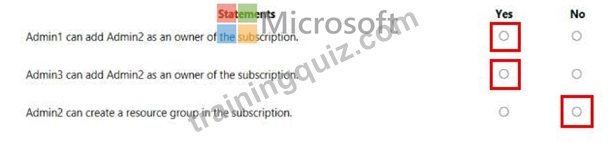
Reference:
https://docs.microsoft.com/en-gb/azure/role-based-access-control/elevate-access-global-admin
NEW QUESTION 216
You need to recommend a solution to automate the configuration for the finance department users. The solution must meet the technical requirements.
What should you include in the recommended?
- A. Azure AD Identity Protection
- B. an Azure logic app and the Microsoft Identity Management (MIM) client
- C. Azure AP B2C
- D. dynamic groups and conditional access policies
Answer: D
Explanation:
Explanation
Scenario: Ensure Azure Multi-Factor Authentication (MFA) for the users in the finance department only.
The recommendation is to use conditional access policies that can then be targeted to groups of users, specific applications, or other conditions.
References:
https://docs.microsoft.com/en-us/azure/active-directory/authentication/howto-mfa-userstates
Topic 3, Contoso Ltd
Overview
Contoso, Ltd. is a manufacturing company that has offices worldwide. Contoso works with partner organizations to bring products to market.
Contoso products are manufactured by using blueprint files that the company authors and maintains.
Existing Environment
Currently, Contoso uses multiple types of servers for business operations, including the following:
* File servers
* Domain controllers
* Microsoft SQL Server servers
Your network contains an Active Directory forest named contoso.com. All servers and client computers are joined to Active Directory.
You have a public-facing application named App1. App1 is comprised of the following three tiers:
* A SQL database
* A web front end
* A processing middle tier
Each tier is comprised of five virtual machines. Users access the web front end by using HTTPS only.
Requirements
Planned Changes
Contoso plans to implement the following changes to the infrastructure:
Move all the tiers of App1 to Azure.
Move the existing product blueprint files to Azure Blob storage.
Create a hybrid directory to support an upcoming Microsoft Office 365 migration project.
Technical Requirements
Contoso must meet the following technical requirements:
* Move all the virtual machines for App1 to Azure.
* Minimize the number of open ports between the App1 tiers.
* Ensure that all the virtual machines for App1 are protected by backups.
* Copy the blueprint files to Azure over the Internet.
* Ensure that the blueprint files are stored in the archive storage tier.
* Ensure that partner access to the blueprint files is secured and temporary.
* Prevent user passwords or hashes of passwords from being stored in Azure.
* Use unmanaged standard storage for the hard disks of the virtual machines.
* Ensure that when users join devices to Azure Active Directory (Azure AD), the users use a mobile phone to verify their identity.
Minimize administrative effort whenever possible.
User Requirements
Contoso identifies the following requirements for users:
Ensure that only users who are part of a group named Pilot can join devices to Azure AD.
Designate a new user named Admin1 as the service administrator of the Azure subscription.
Ensure that a new user named User3 can create network objects for the Azure subscription.
NEW QUESTION 217
You have an Azure subscription that contains an Azure file share.
You have an on-premises server named Server1 that runs Windows Server 2016.
You plan to set up Azure File Sync between Server1 and the Azure file share.
You need to prepare the subscription for the planned Azure File Sync.
Which two actions should you perform in the Azure subscription? To answer, drag the appropriate actions to the correct targets. Each action may be used once, more than once, or not at all. You may need to drag the split bar between panes or scroll to view content.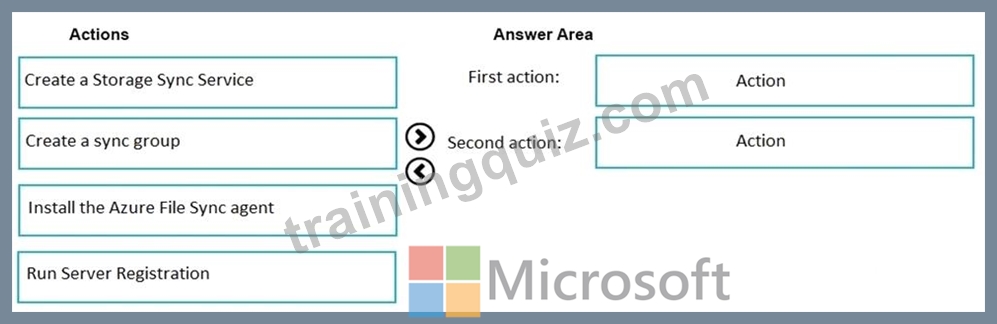
Answer:
Explanation:
Explanation:
First action: Create a Storage Sync Service
The deployment of Azure File Sync starts with placing a Storage Sync Service resource into a resource group of your selected subscription.
Second action: Run Server Registration
Registering your Windows Server with a Storage Sync Service establishes a trust relationship between your server (or cluster) and the Storage Sync Service. A server can only be registered to one Storage Sync Service and can sync with other servers and Azure file shares associated with the same Storage Sync Service.
The Server Registration UI should open automatically after installation of the Azure File Sync agent.
Incorrect Answers:
Not Install the Azure File Sync agent: The Azure File Sync agent is a downloadable package that enables Windows Server to be synced with an Azure file share.
NEW QUESTION 218
You need to configure the Device settings to meet the technical requirements and the user requirements.
Which two settings should you modify? To answer, select the appropriate settings in the answer area.
Answer:
Explanation:
Explanation
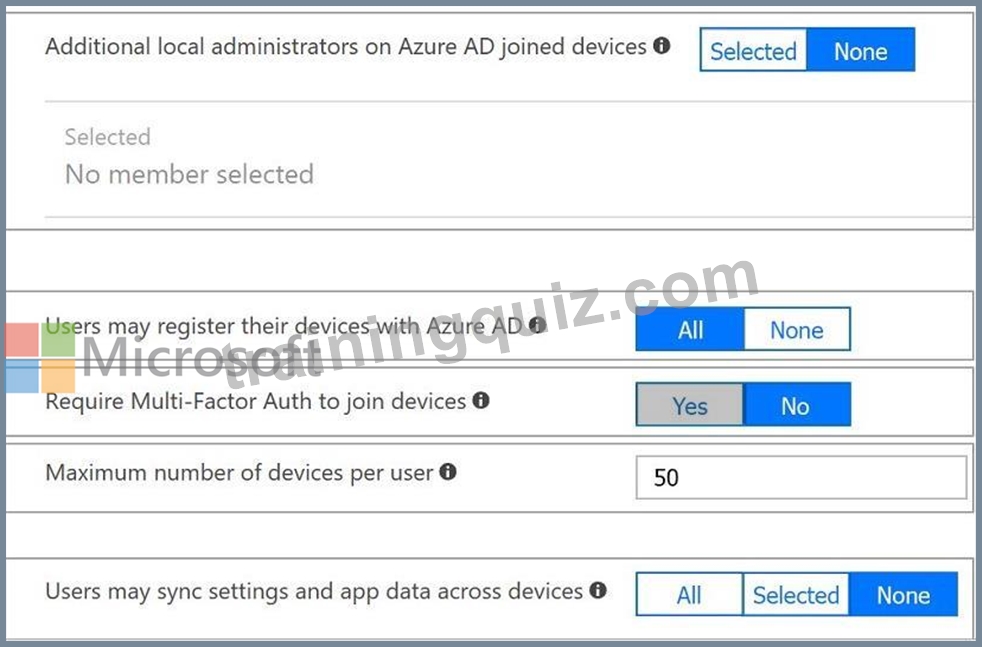
Box 1: Selected
Only selected users should be able to join devices
Box 2: Yes
Require Multi-Factor Auth to join devices.
From scenario:
* Ensure that only users who are part of a group named Pilot can join devices to Azure AD
* Ensure that when users join devices to Azure Active Directory (Azure AD), the users use a mobile phone to verify their identity.
NEW QUESTION 219
Note: This question is part of a series of questions that present the same scenario. Each question in the series contains a unique solution that might meet the stated goals. Some question sets might have more than one correct solution, while others might not have a correct solution.
After you answer a question in this section, you will NOT be able to return to it. As a result, these questions will not appear in the review screen.
You have an Azure subscription that contains 10 virtual networks. The virtual networks are hosted in separate resource groups.
Another administrator plans to create several network security groups (NSGs) in the subscription.
You need to ensure that when an NSG is created, it automatically blocks TCP port 8080 between the virtual networks.
Solution: You assign a built-in policy definition to the subscription.
Does this meet the goal?
- A. No
- B. Yes
Answer: A
Explanation:
Resource policy definition used by Azure Policy enables you to establish conventions for resources in your organization by describing when the policy is enforced and what effect to take.
By defining conventions, you can control costs and more easily manage your resources.
Reference:
https://docs.microsoft.com/en-us/azure/azure-policy/policy-definition
NEW QUESTION 220
You need to create an Azure Storage account that meets the following requirements:
* Minimizes costs
* Supports hot, cool, and archive blob tiers
* Provides fault tolerance if a disaster affects the Azure region where the account resides How should you complete the command? To answer, select the appropriate options in the answer are a. NOTE: Each correct selection is worth one point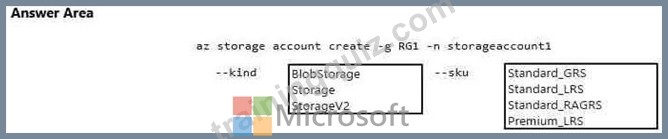
Answer:
Explanation: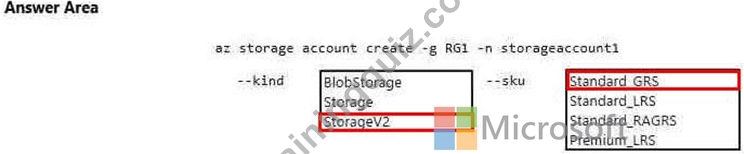
Explanation:
Box 1: StorageV2
You may only tier your object storage data to hot, cool, or archive in Blob storage and General Purpose v2 (GPv2) accounts. General Purpose v1 (GPv1) accounts do not support tiering.
General-purpose v2 accounts deliver the lowest per-gigabyte capacity prices for Azure Storage, as well as industry-competitive transaction prices.
Box 2: Standard_GRS
Geo-redundant storage (GRS): Cross-regional replication to protect against region-wide unavailability.
Incorrect Answers:
Locally-redundant storage (LRS): A simple, low-cost replication strategy. Data is replicated within a single storage scale unit.
Read-access geo-redundant storage (RA-GRS): Cross-regional replication with read access to the replica. RA-GRS provides read-only access to the data in the secondary location, in addition to geo-replication across two regions, but is more expensive compared to GRS.
References:
https://docs.microsoft.com/en-us/azure/storage/common/storage-redundancy-grs
https://docs.microsoft.com/en-us/azure/storage/blobs/storage-blob-storage-tiers
NEW QUESTION 221
From Azure Active Directory (AD) Privileged Identify Management, you configure the Role settings for the Owner role of an Azure subscription as shown in the following exhibit.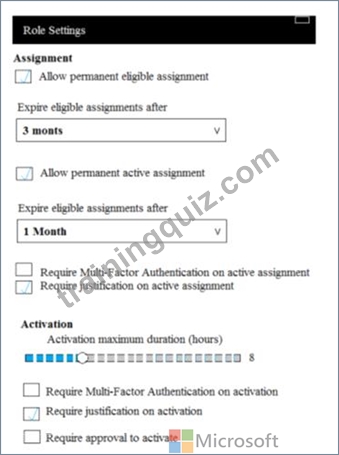
From Azure AD Privileged Identify Management, you assign the Owner role for the subscription to a user named User1, and you set the Assignment type to Active and Permanently eligible.
Use the drop-down menus to select the answer choice that completes each statement based on the information presented in the graphic.
NOTE: Each correct selection is worth one point.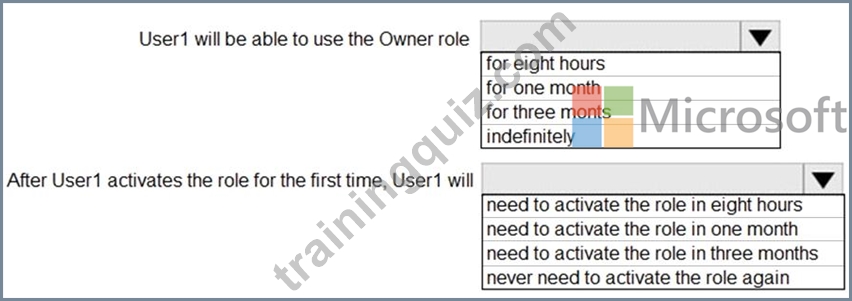
Answer:
Explanation:
Reference:
https://docs.microsoft.com/en-us/azure/active-directory/privileged-identity-management/pim-how-to-add-role-to-user?tabs=new
NEW QUESTION 222
You have an Azure subscription named Subscription1. Subscription1 contains a virtual machine named VM1.
You install and configure a web server and a DNS server on VM1.
VM1 has the effective network security rules shown in the following exhibit.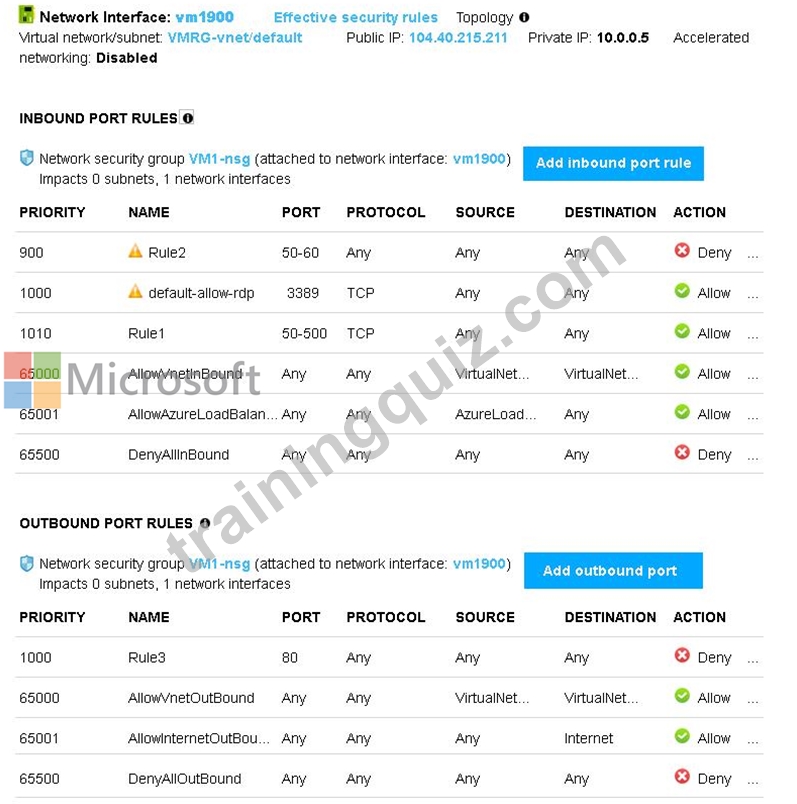
Use the drop-down menus to select the answer choice that completes each statement based on the information presented in the graphic.
NOTE: Each correct selection is worth one point.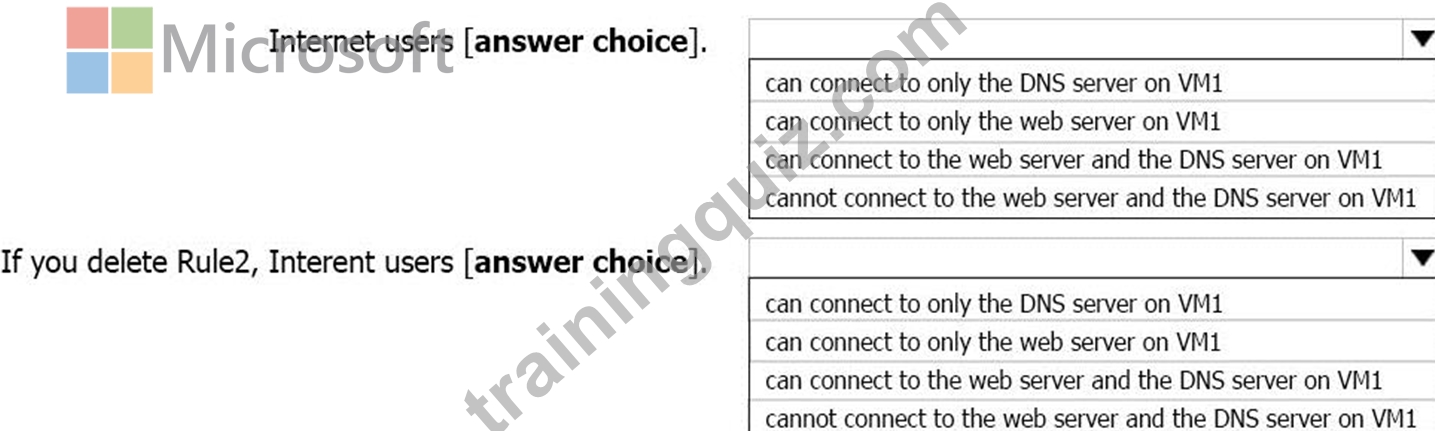
Answer:
Explanation: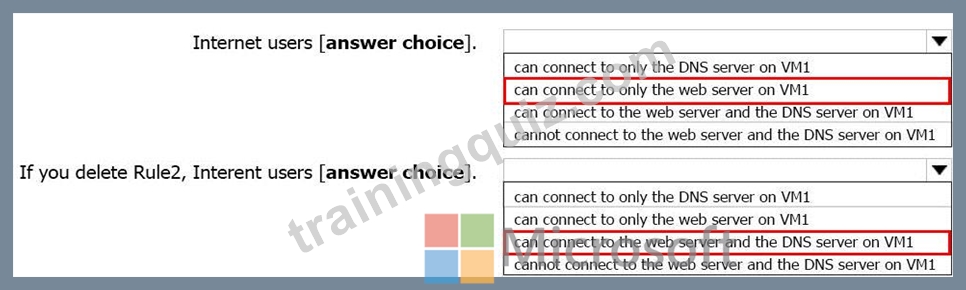
NEW QUESTION 223
You are deploying a containerized web application in Azure.
When deploying the web app, which of the following are valid container image sources?
- A. Docker hub
- B. On-premises
- C. Virtual machine
- D. ACR
Answer: A,D
Explanation:
Explanation
When you create a web app from a Docker image, you configure the following properties:
* The registry that contains the image. The registry can be Docker Hub, Azure Container Registry (ACR), or some other private registry.
* The image :This item is the name of the repository.
* The tag : This item indicates which version of the image to use from the repository. By convention, the most recent version is given the tag latest when it's built.
* Startup File :This item is the name of an executable file or a command to be run when the image is loaded.
It's equivalent to the command that you can supply to Docker when running an image from the command line by using docker run. If you're deploying a ready-to-run, containerized app that already has the ENTRYPOINT and/or COMMAND values configured, you don't need to fill this in.
ence:
https://docs.microsoft.com/en-us/learn/modules/deploy-run-container-app-service/4-deploy-web-app
NEW QUESTION 224
You manage two Azure subscriptions named Subscription1 and Subscription2.
Subscription1 has the following virtual networks: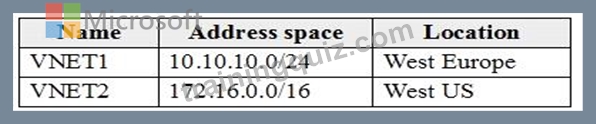
The virtual networks contain the following subnets: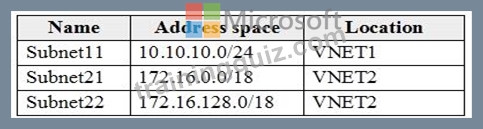
Subscription2 contains the following virtual network:
* Name: VNETA
* Address space: 10.10.128.0/17
* Location: Canada Central
VNETA contains the following subnets: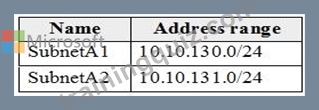
For each of the following statements, select Yes if the statement is true. Otherwise, select No.
NOTE: Each correct selection is worth one point.
Answer:
Explanation:
Explanation:
Box 1: Yes
With VNet-to-VNet you can connect Virtual Networks in Azure across Different regions.
Box 2: Yes
Azure supports the following types of peering:
Virtual network peering: Connect virtual networks within the same Azure region.
Global virtual network peering: Connecting virtual networks across Azure regions.
Box 3: No
The virtual networks you peer must have non-overlapping IP address spaces.
References:
https://azure.microsoft.com/en-us/blog/vnet-to-vnet-connecting-virtual-networks-in-azure-across-different-regions/
https://docs.microsoft.com/en-us/azure/virtual-network/virtual-network-manage-peering#requirements-and-constraints
NEW QUESTION 225
You have a pay-as-you-go Azure subscription that contains the virtual machines shown in the following table.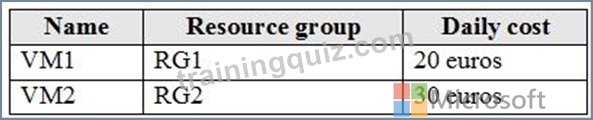
You create the budget shown in the following exhibit.
The AG1 action group contains a user named [email protected] only.
Use the drop-down menus to select the answer choice that completes each statement based on the information presented in the graphic.
NOTE: Each correct selection is worth one point.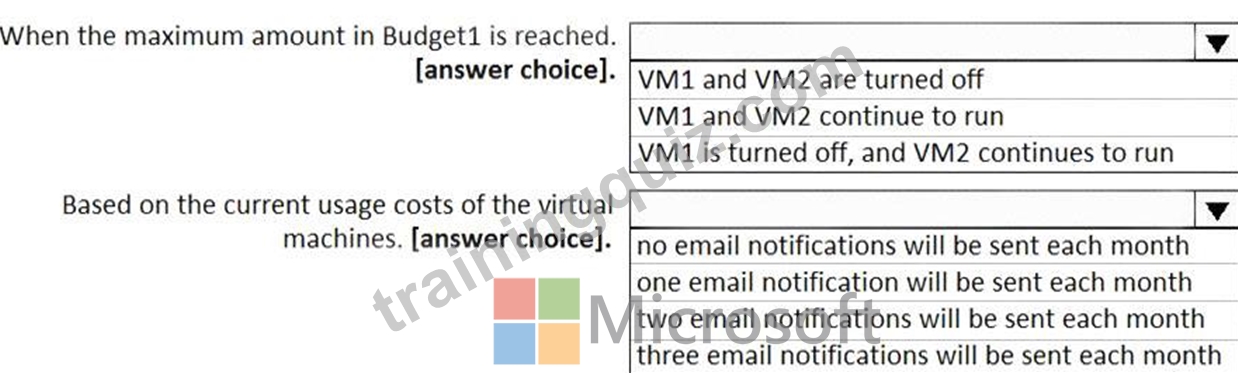
Answer:
Explanation: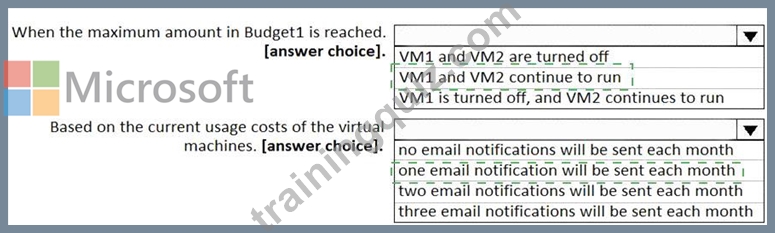
Explanation
Box 1: VM1 and VM2 continues to run
When the budget thresholds you've created are exceeded, only notifications are triggered. None of your resources are affected and your consumption isn't stopped. You can use budgets to compare and track spending as you analyze costs.
Box 2: one email notification will be sent each month
Budget alerts for Resource Group RG1, which include VM1, but not VM2.VM1 consumes 20 Euro/day. The
50% ,500 Euro limit, will be reached in 25 days, and an email will be sent.
The 70% and 100% alert conditions will not be reached within a month, and they don't trigger email actions anyway.
References:
https://docs.microsoft.com/en-gb/azure/cost-management-billing/costs/tutorial-acm-create-budgets
https://docs.microsoft.com/en-us/azure/cost-management-billing/costs/cost-mgt-alerts-monitor-usage-spending
NEW QUESTION 226
You need to use Azure Automation State Configuration to manage the ongoing consistency of virtual machine configurations.
Which five actions should you perform in sequence? To answer, move the appropriate action from the list of actions to the answer area and arrange them in the correct order.
NOTE: More than one order of answer choices is correct. You will receive credit for any of the correct orders you select.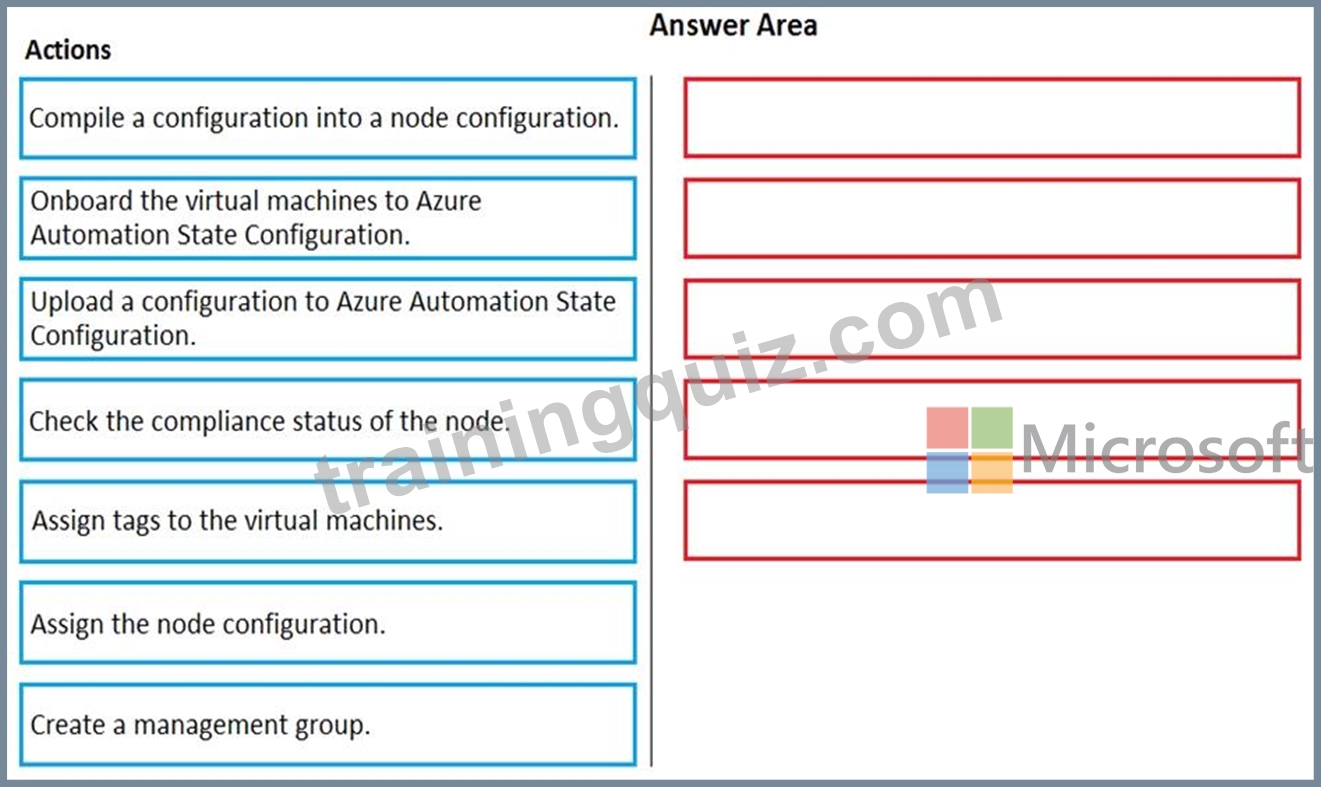
Answer:
Explanation:
Explanation:
Step 1: Upload a configuration to Azure Automation State Configuration.
Import the configuration into the Automation account.
Step 2: Compile a configuration into a node configuration.
A DSC configuration defining that state must be compiled into one or more node configurations (MOF document), and placed on the Automation DSC Pull Server.
Step 3: Onboard the virtual machines to Azure Automation State Configuration.
Onboard the Azure VM for management with Azure Automation State Configuration Step 4: Assign the node configuration Step 5: Check the compliance status of the node Each time Azure Automation State Configuration performs a consistency check on a managed node, the node sends a status report back to the pull server. You can view these reports on the page for that node.
On the blade for an individual report, you can see the following status information for the corresponding consistency check:
The report status - whether the node is "Compliant", the configuration "Failed", or the node is "Not Compliant" References:
https://docs.microsoft.com/en-us/azure/automation/automation-dsc-getting-started
NEW QUESTION 227
HOTSPOT
You have Azure virtual machines that run Windows Server 2019 and are configured as shown in the following table.
You create a private Azure DNS zone named adatum.com. You configure the adatum.com zone to allow auto registration from VNET1.
Which A records will be added to the adatum.com zone for each virtual machine? To answer, select the appropriate options in the answer area.
NOTE: Each correct selection is worth one point.
Hot Area:
Answer:
Explanation:
Section: [none]
Explanation:
The virtual machines are registered (added) to the private zone as A records pointing to their private IP addresses.
Reference:
https://docs.microsoft.com/en-us/azure/dns/private-dns-overview
https://docs.microsoft.com/en-us/azure/dns/private-dns-scenarios
NEW QUESTION 228
You have an Azure subscription named Sub1.
You plan to deploy a multi-tiered application that will contain the tiers shown in the following table.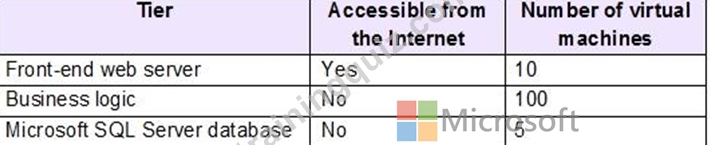
You need to recommend a networking solution to meet the following requirements:
* Ensure that communication between the web servers and the business logic tier spreads equally across the virtual machines.
* Protect the web servers from SQL injection attacks.
Which Azure resource should you recommend for each requirement? To answer, select the appropriate options in the answer area.
NOTE: Each correct selection is worth one point.
Answer:
Explanation: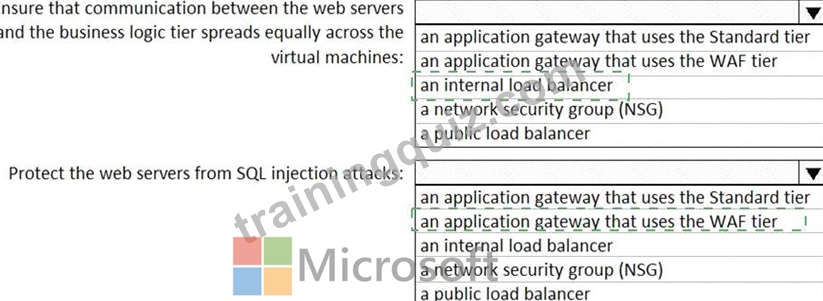
Explanation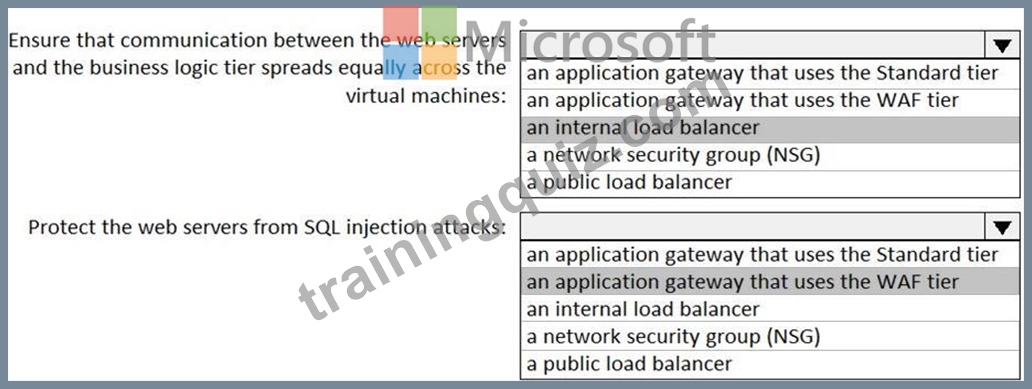
Box 1: an internal load balancer
Azure Internal Load Balancer (ILB) provides network load balancing between virtual machines that reside inside a cloud service or a virtual network with a regional scope.
Box 2: an application gateway that uses the WAF tier
Azure Web Application Firewall (WAF) on Azure Application Gateway provides centralized protection of your web applications from common exploits and vulnerabilities. Web applications are increasingly targeted by malicious attacks that exploit commonly known vulnerabilities.
References:
https://docs.microsoft.com/en-us/azure/web-application-firewall/ag/ag-overview
NEW QUESTION 229
VM1 is running and connects to NIC1 and Disk1. NIC1 connects to VNET1.
RG2 contains a public IP address named IP2 that is in the East US location. IP2 is not assigned to a virtual machine.
For each of the following statements, select Yes if the statement is true. Otherwise, select No.
NOTE: Each correct selection is worth one point.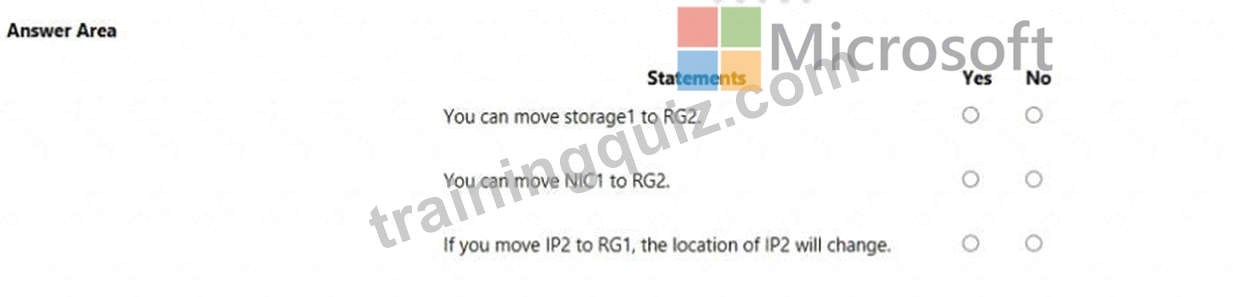
Answer:
Explanation: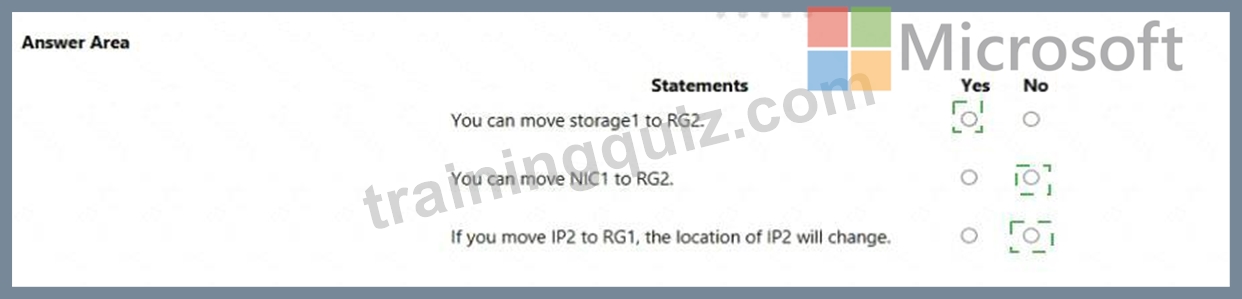
Explanation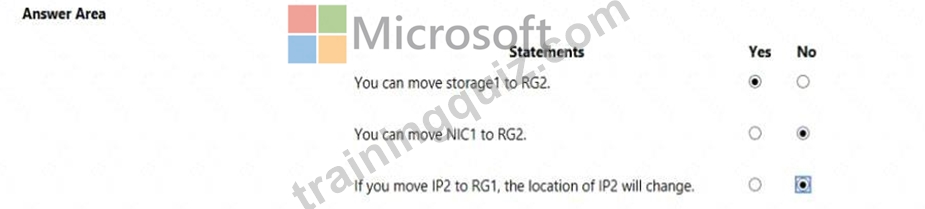
NEW QUESTION 230
You plan to deploy five virtual machines to a virtual network subnet.
Each virtual machine will have a public IP address and a private IP address.
Each virtual machine requires the same inbound and outbound security rules.
What is the minimum number of network interfaces and network security groups that you require? To answer, select the appropriate options in the answer area.
NOTE: Each correct selection is worth one point.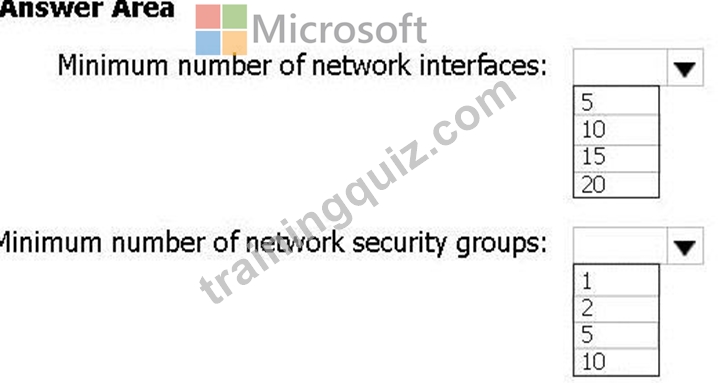
Answer:
Explanation: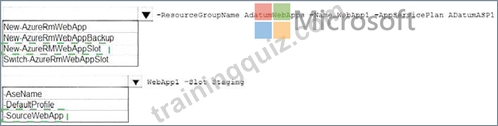
Explanation
Box 1: 5
A public and a private IP address can be assigned to a single network interface.
Box 2: 1
You can associate zero, or one, network security group to each virtual network subnet and network interface in a virtual machine. The same network security group can be associated to as many subnets and network interfaces as you choose.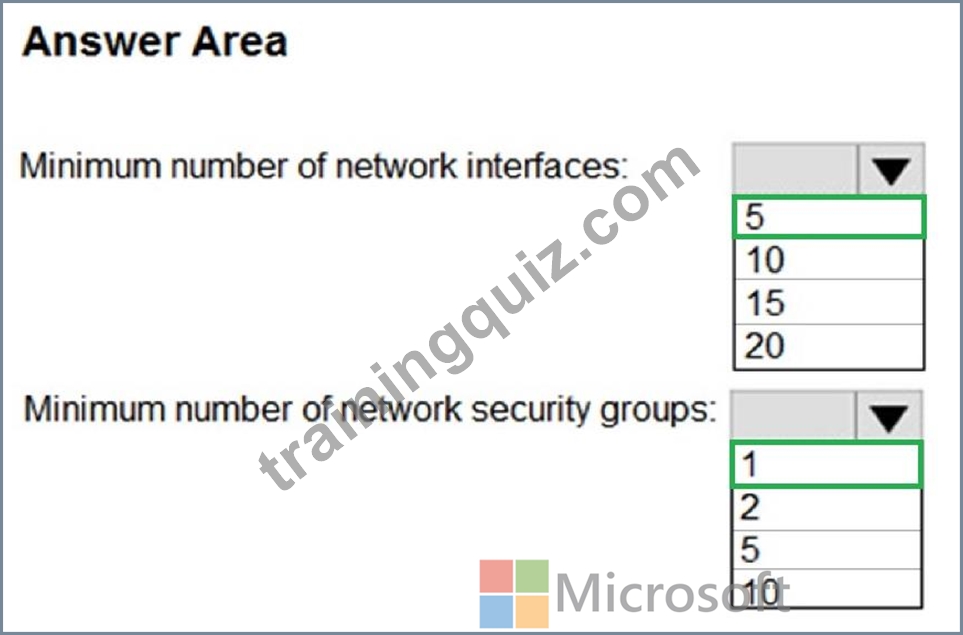
Reference:
https://docs.microsoft.com/en-us/azure/virtual-network/virtual-network-network-interface-addresses
NEW QUESTION 231
......
Authentic Best resources for AZ-104 Online Practice Exam: https://www.trainingquiz.com/AZ-104-practice-quiz.html
Get the superior quality AZ-104 Dumps with explanations waiting just for you, get it now: https://drive.google.com/open?id=1DBoPVeU9Z3gS7IQGLIbUsdaLLE3bOzO0
