

Prepare AZ-104 Question Answers Free Update With 100% Exam Passing Guarantee [2026]
Dumps Real Microsoft AZ-104 Exam Questions [Updated 2026]
How can you enhance your Microsoft AZ-104 Exam skills?
Microsoft Azure is a fast-growing technology company in the world which has a huge number of opportunities in front of it. Before appearing for the exam, candidates should have a clear idea about this company and should have a proper understanding about its services. Traffic management, management of Internet of Things (IoT), storage and virtual networking are some services of this company which can help you to develop your career. Balancing of different aspects and taking correct decisions with proper facts and figures is the most important factor in the career. Subnet mask is a big issue for candidates. Processes related to adding, manipulation and moving the resources are important for candidates who want to do well in AZ-104:Microsoft Azure Administrator Exam. Processes related to reading and writing the storage files are also required for candidates. Microsoft AZ-104 exam dumps are important for getting good marks in the exam. Overall, the knowledge of networking protocols and their knowledge helps in increasing the score in AZ-104:Microsoft Azure Administrator Exam.
Process of storage involves the creation of the storage account, storage services, location setting and pricing. Secure authentication and encryption is important for storing data in Azure. Interface used to access the storage includes PowerShell. Rules are used to write the storage policies. Object is used as an extension of the storage account. View allows the users to view the resources of storage. Demonstrate the procedures for listing, creating and deleting the files and directories. Real Time Compression is used for compressing the data in the real time. Hard disk is used for storing the data. Connect to a storage account, create a container and upload data. Lifecycle policies are used for managing the data in Azure.
Kubernetes is a container orchestrator which helps in simple deployment and management of containerized applications. Team of developers and IT professionals work together to create and manage the cluster.
How to Prepare For AZ-104:Microsoft Azure Administrator Exam
Preparation Guide for AZ-104:Microsoft Azure Administrator Exam
Introduction
The Microsoft az-104 certification exam is important to your career but can be difficult to prepare for. This blog post will help you learn about the 100 questions on the exam based on previous exams, take practice exams based on sample questions, and increase your chances of passing. The Microsoft az-104 certification is a test that measures how well-experienced professionals understand software design principles provided by Azure. This test is part of the Professional Developer license program that requires an official nugget from Microsoft in order to achieve this certification status.
What Is It All about?
This Microsoft exam checks the candidate's knowledge at multiple levels and tries to turn them into a real-world problem-solver. To make this happen, AZ-104 extensively covers five domains such as:
- Managing Azure identities & governance;
- Implementing & managing storage;
- Configuring & handling virtual networking;
- Deploying & controlling Azure compute resources;
- Monitoring Azure resources.
In particular, the first area focuses on notions like Azure AD object management, role-based access control management, Azure subscription, and governance. Thus, you will learn how to create users & groups and how to manage them properly, how to provide customers with necessary Azure resources, and the way Cost Management is configured. In addition, you will get to know more about resources like VM, will learn how to apply tags, and configure locks as well as Azure policies.
The second domain puts much stress on configuration of VMs for high availability as well as scalability, their deployment and configuration. Here, you will also get to know more about Azure Disk Encryption, Azure Kubernetes Service, and Azure Container Instances. To know more, within this section, you'll get equipped with such notions as ARM template, will know how to add data discs, design and implement App Service and App Service Plans. Finally, here, you will also understand how to deploy the VHD template and redeploy VMs.
The third topic is dedicated to Azure Storage, including the blob one. Through this area, you will learn how to configure Azure File Sync service and how to copy information by using AZCopy. Moreover, candidates will learn how to take advantage of accounts for storage and deal with pieces of data within Azure Storage. At last, one will be taught to utilize the Azure Storage Explorer, create a share of Azure files, and implement store tiers for Azure blobs.
Finally, the last two domains talk about virtual networks like VNET peering, IP addresses, subnets, and Azure back-up & data recovery. In addition, here, you will become knowledgeable about how to make use of Azure Monitor and how to put into practice a Log Analytics workspace. Also, with the help of these objectives, you will understand how to access virtual networks securely, how to manage load balancing effectively, how to create Recovery Services Vault, and manage various queries. Finally, within this area, candidates will learn how to deal with review backup reports and how to operate with Azure VPN Gateway, ExpressRoute, and Azure Virtual WAN.
This way, AZ-104 makes a candidate equipped enough to address real-world Azure-related issues and become a seasoned Azure Administrator.
NEW QUESTION # 39
You have an Azure virtual machine named VM1 and a Recovery Services vault named Vault1.
You create a backup Policy1 as shown in the exhibit. (Click the Exhibit tab.)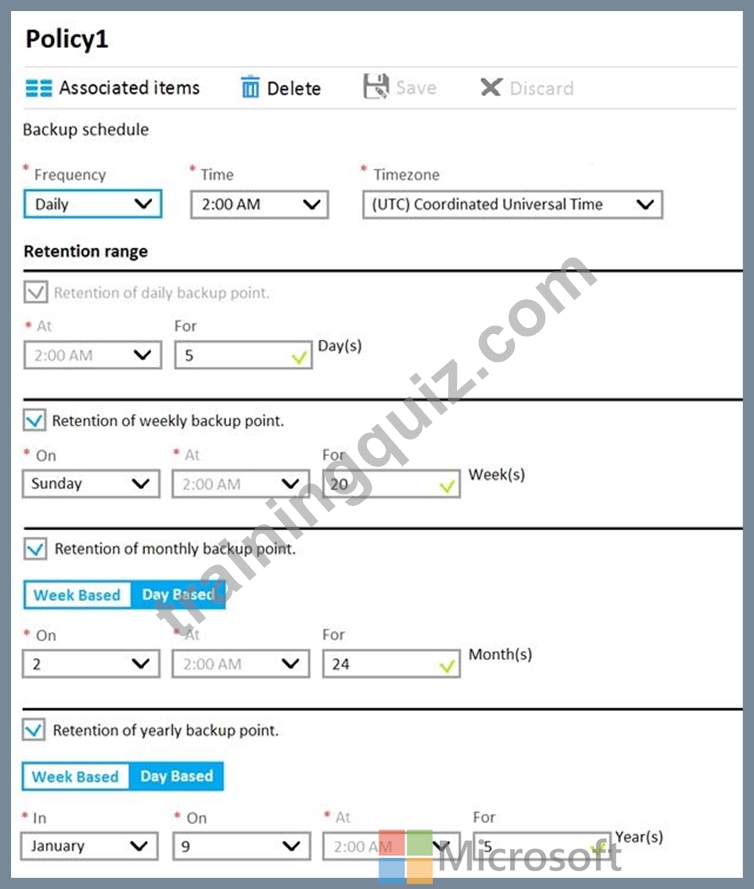
You configure the backup of VM1 to use Policy1 on Thursday, January 1.
You need to identify the number of available recovery points for VM1.
How many recovery points are available on January 8 and on January 15? To answer, select the appropriate options in the answer area.
NOTE: Each correct selection is worth one point.
Answer:
Explanation: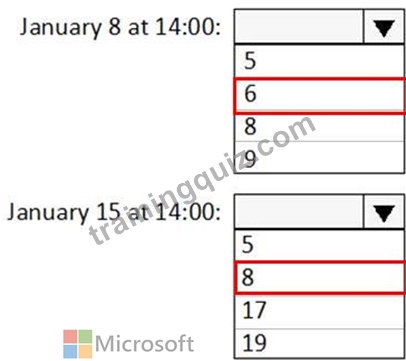
NEW QUESTION # 40
You have an Azure subscription named Sub1 that contains the resources shown in the following table.
Sub1 contains the following alert rule:
* Name: Alert!
* Scope: All resource groups in Sub1
o Include all future resources
* Condition: All administrative operations
* Actions: Action1
Sub1 contains the following alert processing rule:
* Name: Rule1
* Scope: Sub1
* Rule type: Suppress notifications
* Apply the rule: On a specific time
o Stan: August 10. 2022
o End: August 13. 2022
For each of the following statements, select Yes if the statement is true. Otherwise, select No.
NOTE: Each correct selection is worth one point.
Answer:
Explanation:
NEW QUESTION # 41
You need to identify the storage requirements for Contoso.
For each of the following statements, select Yes if the statement is true. Otherwise, select No.
NOTE: Each correct selection is worth one point.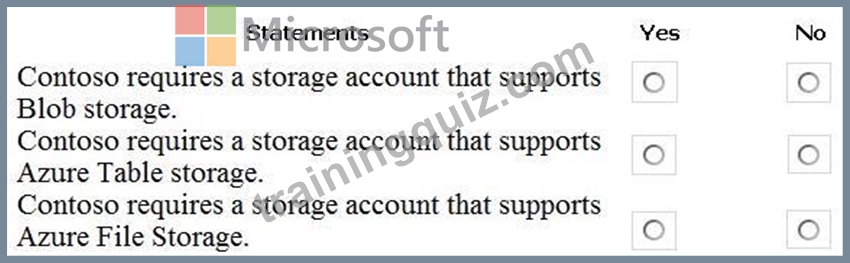
Answer:
Explanation: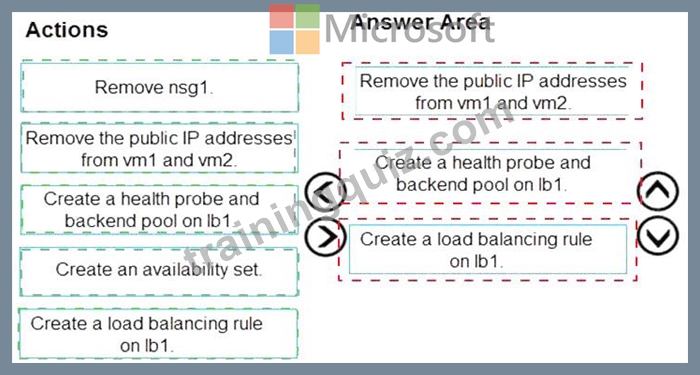
Explanation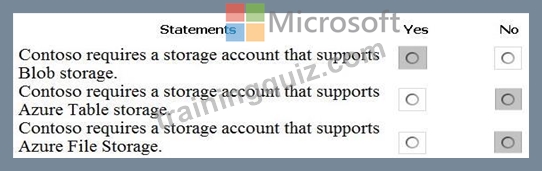
Statement 1: Yes
Contoso is moving the existing product blueprint files to Azure Blob storage which will ensure that the blueprint files are stored in the archive storage tier.
Use unmanaged standard storage for the hard disks of the virtual machines. We use Page Blobs for these.
Statement 2: No
Azure Table storage stores large amounts of structured data. The service is a NoSQL datastore which accepts authenticated calls from inside and outside the Azure cloud. Azure tables are ideal for storing structured, non-relational data. Common uses of Table storage include:
1. Storing TBs of structured data capable of serving web scale applications
2. Storing datasets that don't require complex joins, foreign keys, or stored procedures and can be denormalized for fast access
3. Quickly querying data using a clustered index
4. Accessing data using the OData protocol and LINQ queries with WCF Data Service .NET Libraries Statement 3: No File Storage can be used if your business use case needs to deal mostly with standard File extensions like
*.docx, *.png and *.bak then you should probably go with this storage option.
Reference:
https://docs.microsoft.com/en-us/azure/machine-learning/team-data-science-process/move-data-to-azure-blob-us
https://docs.microsoft.com/en-us/azure/storage/tables/table-storage-overview
https://www.serverless360.com/blog/azure-blob-storage-vs-file-storage
NEW QUESTION # 42
Note: This question is part of a series of questions that present the same scenario. Each question in the series contains a unique solution that might meet the stated goals. Some question sets might have more than one correct solution, while others might not have a correct solution.
After you answer a question in this section, you will NOT be able to return to it. As a result, these questions will not appear in the review screen.
You have an Azure subscription that contains the following resources:
* A virtual network that has a subnet named Subnet1
* Two network security groups (NSGs) named NSG-VM1 and NSG-Subnet1
* A virtual machine named VM1 that has the required Windows Server configurations to allow Remote Desktop connections NSG-Subnet1 has the default inbound security rules only.
NSG-VM1 has the default inbound security rules and the following custom inbound security rule:
* Priority: 100
* Source: Any
* Source port range: *
* Destination: *
* Destination port range: 3389
* Protocol: UDP
* Action: Allow
VM1 connects to Subnet1. NSG1-VM1 is associated to the network interface of VM1. NSG-Subnet1 is associated to Subnet1.
You need to be able to establish Remote Desktop connections from the internet to VM1.
Solution: You add an inbound security rule to NSG-Subnet1 and NSG-VM1 that allows connections from the internet source to the VirtualNetwork destination for port range 3389 and uses the TCP protocol.
Does this meet the goal?
- A. No
- B. Yes
Answer: B
Explanation:
The default port for RDP is TCP port 3389. A rule to permit RDP traffic must be created automatically when you create your VM.
Note on NSG-Subnet1: Azure routes network traffic between all subnets in a virtual network, by default.
References:
https://docs.microsoft.com/en-us/azure/virtual-machines/troubleshooting/troubleshoot-rdp-connection
NEW QUESTION # 43
You have an Azure subscription that contains a storage account named storage1. The subscription is linked to an Azure Active Directory (Azure AD) tenant named contoso.com that syncs to an on-premises Active Directory domain.
The domain contains the security principals shown in the following table.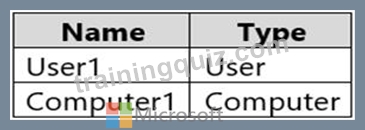
In Azure AD, you create a user named User2.
The storage1 account contains a file share named share1 and has the following configurations.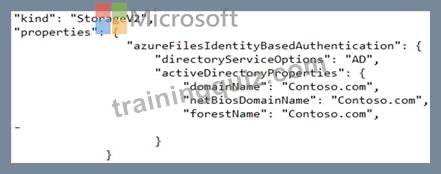
For each of the following statements, select Yes if the statement is true. Otherwise, select No.
NOTE: Each correct selection is worth one point.
Answer:
Explanation:
Reference:
https://docs.microsoft.com/en-us/azure/storage/files/storage-files-identity-ad-ds-assign-permissions?tabs=azure-portal
NEW QUESTION # 44
You have a virtual network named VNet1 that has the configuration shown in the following exhibit.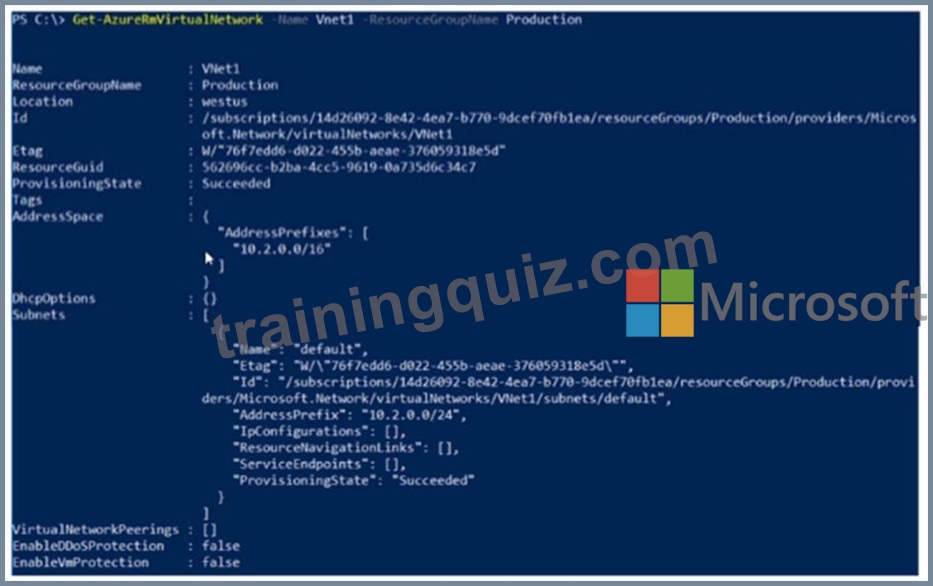
Use the drop-down menus to select the answer choice that completes each statement based on the information presented in the graphic.
NOTE: Each correct selection is worth one point.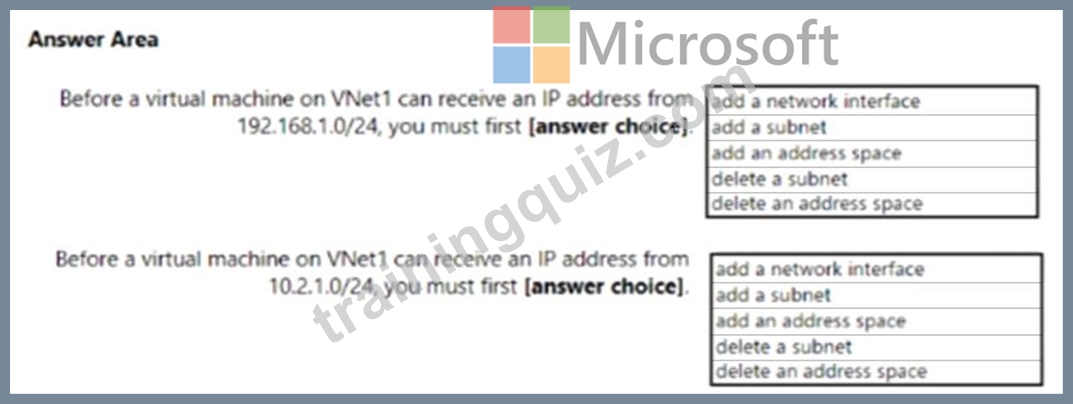
Answer:
Explanation: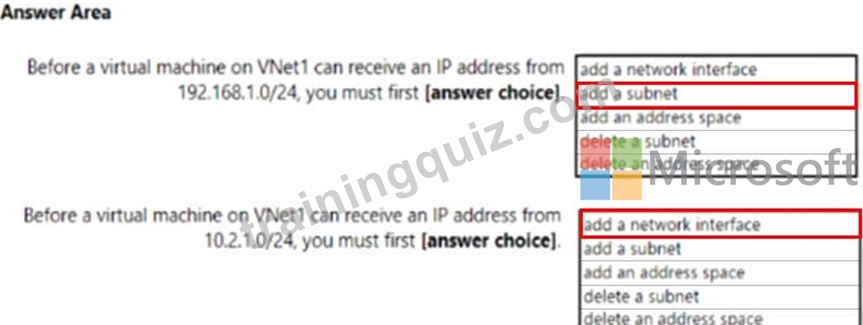
Explanation:
Box 1: add an address space
Your IaaS virtual machines (VMs) and PaaS role instances in a virtual network automatically receive a private IP address from a range that you specify, based on the address space of the subnet they are connected to. We need to add the 192.168.1.0/24 address space.
Box 2: add a subnet
Address space is present but need to add subnet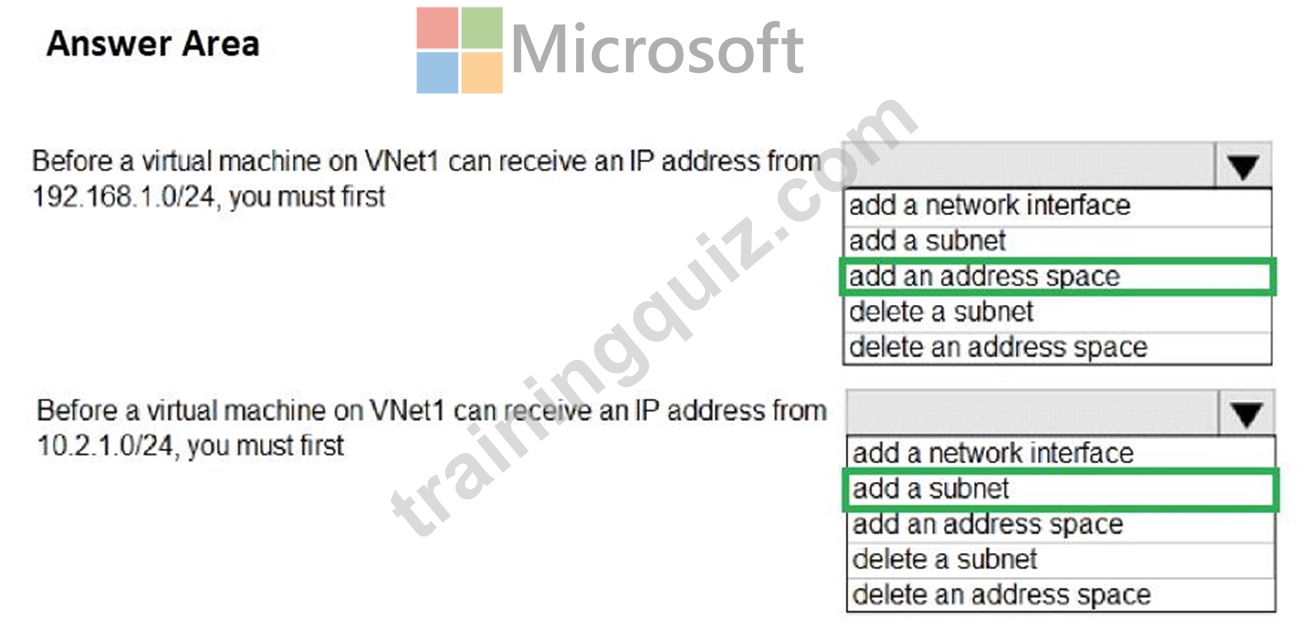
References:
https://docs.microsoft.com/en-us/microsoft-365/solutions/cloud-architecture-models?view=o365-worldwide
https://docs.microsoft.com/en-us/azure/virtual-network/virtual-networks-static-private-ip-arm-pportal
NEW QUESTION # 45
You have peering configured as shown in the following exhibit.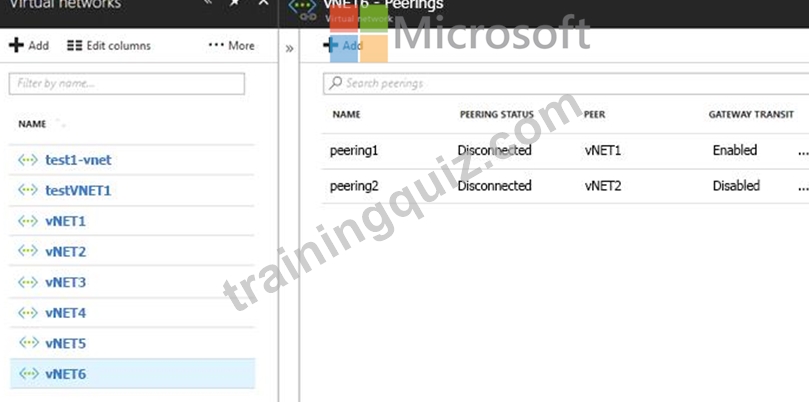
Use the drop-down menus to select the answer choice that completes each statement based on the information presented in the graphic.
NOTE: Each correct selection is worth one point.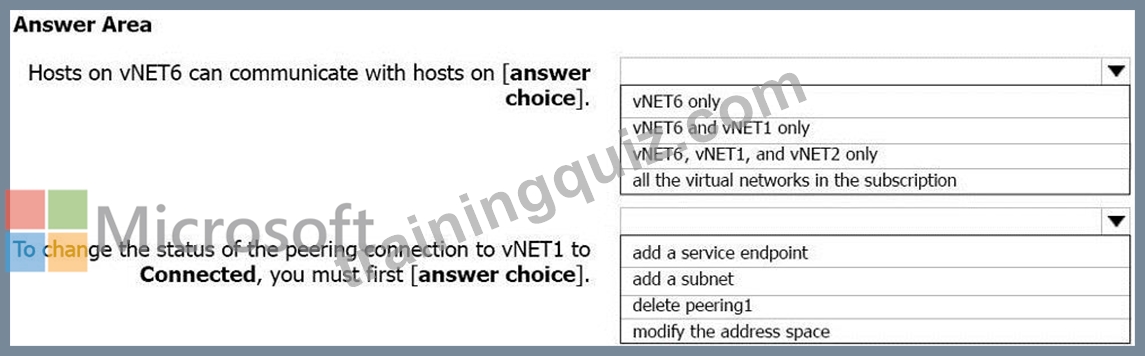
Answer:
Explanation: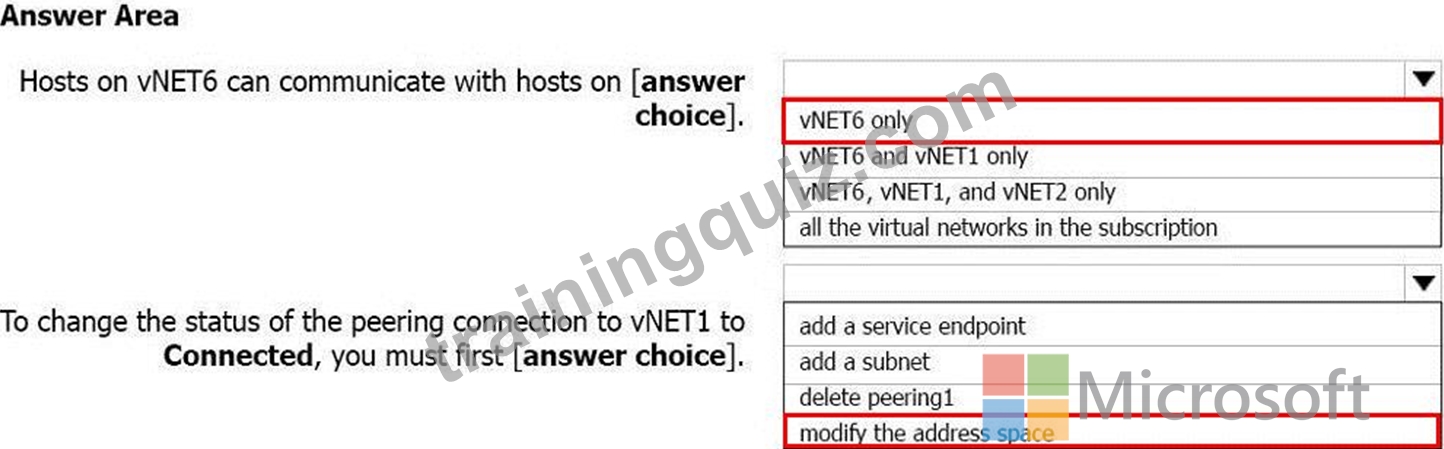
Explanation:
Box 1: vNET6 only
Peering status to both VNet1 and Vnet2 are disconnected.
Box 2: delete peering1
Peering to Vnet1 is Enabled but disconnected. We need to update or re-create the remote peering to get it back to Initiated state.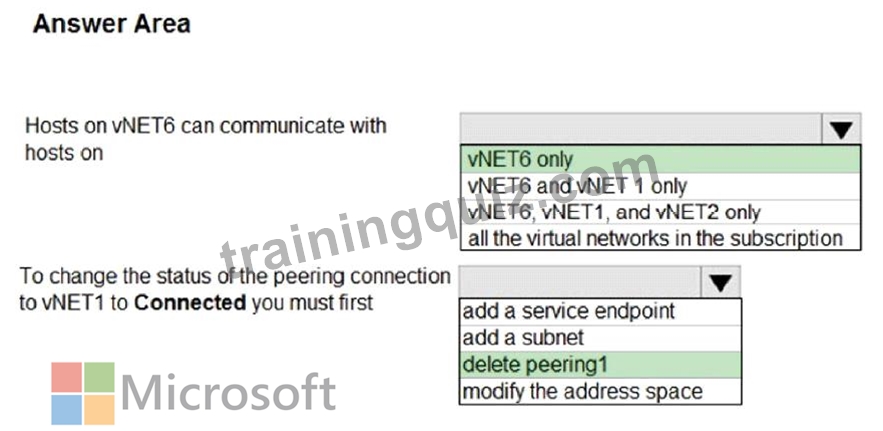
Reference:
https://blog.kloud.com.au/2018/10/19/address-space-maintenance-with-vnet-peering/
https://docs.microsoft.com/en-us/azure/virtual-network/virtual-network-manage-peering#requirements-andconstraints
NEW QUESTION # 46
You have an Azure Active Directory tenant named Contoso.com that includes following users: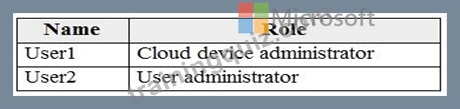
Contoso.com includes following Windows 10 devices: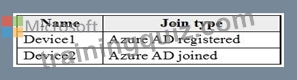
You create following security groups in Contoso.com: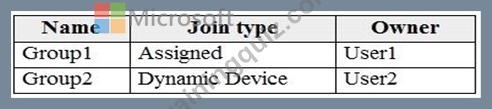
For each of the following statements, select Yes if the statement is true. Otherwise, select No.
NOTE: Each correct selection is worth one point.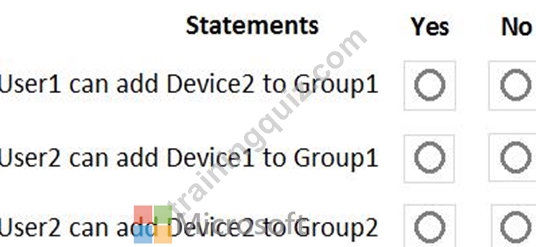
Answer:
Explanation: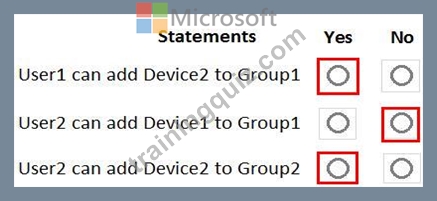
Explanation:
Box 1: Yes
User1 is a Cloud Device Administrator.
Device2 is Azure AD joined.
Group1 has the assigned to join type. User1 is the owner of Group1.
Note: Assigned groups - Manually add users or devices into a static group.
Azure AD joined or hybrid Azure AD joined devices utilize an organizational account in Azure AD Box 2: No User2 is a User Administrator.
Device1 is Azure AD registered.
Group1 has the assigned join type, and the owner is User1.
Note: Azure AD registered devices utilize an account managed by the end user, this account is either a Microsoft account or another locally managed credential.
Box 3: Yes
User2 is a User Administrator.
Device2 is Azure AD joined.
Group2 has the Dynamic Device join type, and the owner is User2.
References:
https://docs.microsoft.com/en-us/azure/active-directory/devices/overview
NEW QUESTION # 47
You plan to deploy 20 Azure virtual machines by using an Azure Resource Manager template. The virtual machines will run the latest version of Windows Server 2016 Datacenter by using an Azure Marketplace image.
You need to complete the storageProfile section of the template.
How should you complete the storageProfile section? To answer, select the appropriate options in the answer area.
NOTE: Each correct selection is worth one point.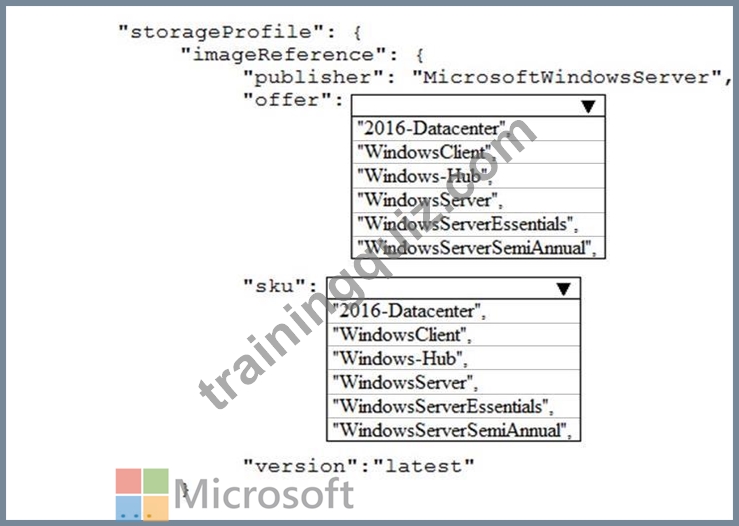
Answer:
Explanation: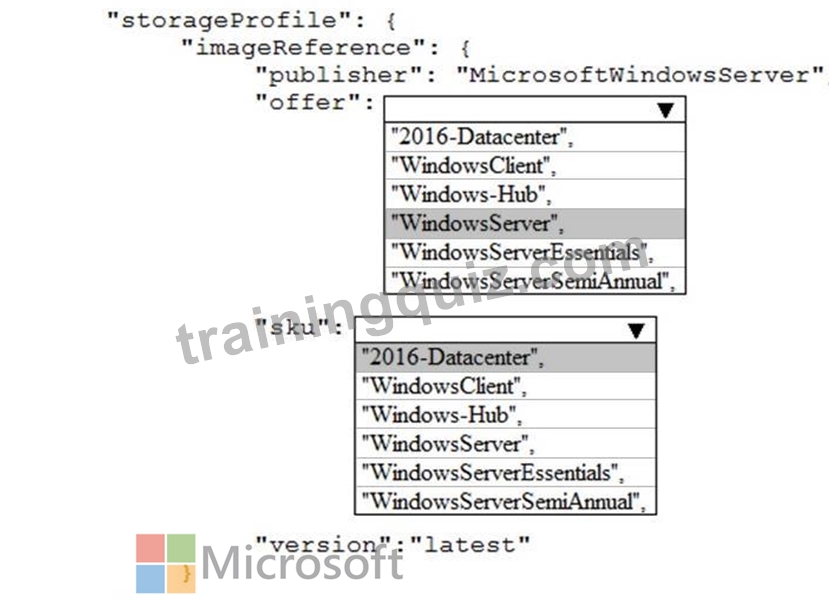
...
"storageProfile": {
"imageReference": {
"publisher": "MicrosoftWindowsServer",
"offer": "WindowsServer",
"sku": "2016-Datacenter",
"version": "latest"
},
...
References:
https://docs.microsoft.com/en-us/rest/api/compute/virtualmachines/createorupdate
NEW QUESTION # 48
You have an Azure subscription. The subscription contains a virtual machine that runs Windows 10.
You need to join the virtual machine to an Active Directory domain.
How should you complete the Azure Resource Manager (ARM) template? To answer, select the appropriate options in the answer area.
NOTE Each correct selection is worth one point.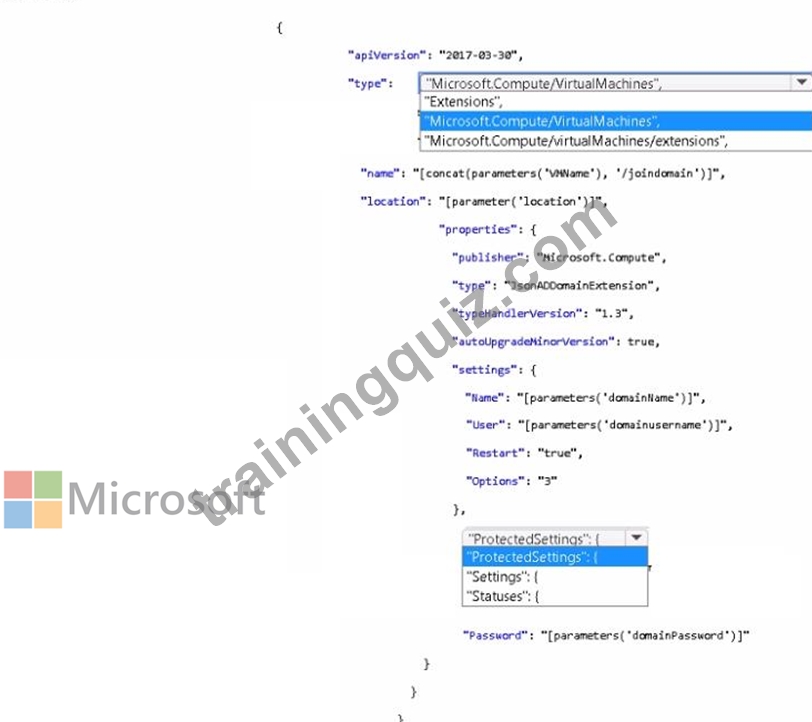
Answer:
Explanation: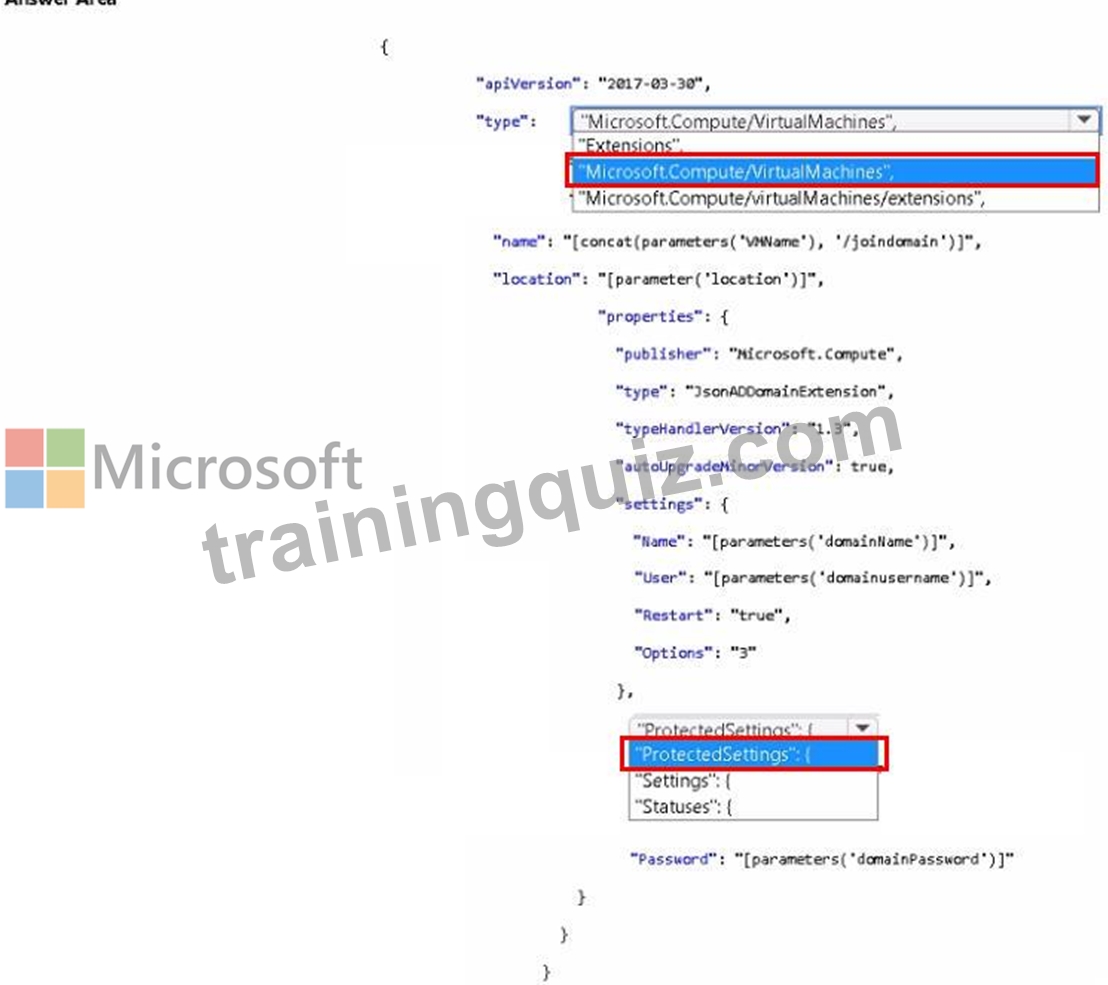
NEW QUESTION # 49
You need to meet the technical requirement for VM4.
What should you create and configure?
- A. an Azure Event Hub
- B. an Azure services Bus
- C. an Azure Notification Hub
- D. an Azure Logic App
Answer: A
Explanation:
Explanation
Scenario: Create a workflow to send an email message when the settings of VM4 are modified.
You can start an automated logic app workflow when specific events happen in Azure resources or third-party resources. These resources can publish those events to an Azure event grid. In turn, the event grid pushes those events to subscribers that have queues, webhooks, or event hubs as endpoints. As a subscriber, your logic app can wait for those events from the event grid before running automated workflows to perform tasks - without you writing any code.
References:
https://docs.microsoft.com/en-us/azure/event-grid/monitor-virtual-machine-changes-event-grid-logic-app
NEW QUESTION # 50
You need to create an Azure Storage account that meets the following requirements:
* Minimizes costs
* Supports hot, cool, and archive blob tiers
* Provides fault tolerance if a disaster affects the Azure region where the account resides
How should you complete the command? To answer, select the appropriate options in the answer area. NOTE: Each correct selection is worth one point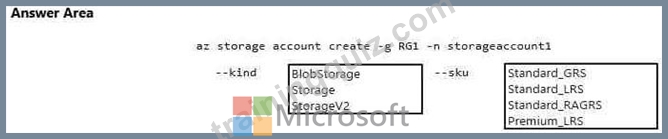
Answer:
Explanation: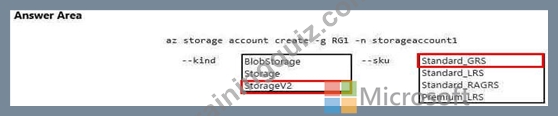
Explanation:
Box 1: StorageV2
You may only tier your object storage data to hot, cool, or archive in Blob storage and General Purpose v2 (GPv2) accounts. General Purpose v1 (GPv1) accounts do not support tiering.
General-purpose v2 accounts deliver the lowest per-gigabyte capacity prices for Azure Storage, as well as industry-competitive transaction prices.
Box 2: Standard_GRS
Geo-redundant storage (GRS): Cross-regional replication to protect against region-wide unavailability.
Incorrect Answers:
Locally-redundant storage (LRS): A simple, low-cost replication strategy. Data is replicated within a single storage scale unit.
Read-access geo-redundant storage (RA-GRS): Cross-regional replication with read access to the replica. RA-GRS provides read-only access to the data in the secondary location, in addition to geo-replication across two regions, but is more expensive compared to GRS.
References:
https://docs.microsoft.com/en-us/azure/storage/common/storage-redundancy-grs
https://docs.microsoft.com/en-us/azure/storage/blobs/storage-blob-storage-tiers
NEW QUESTION # 51
You have an Azure Active Directory (Azure AD) tenant that contains three global administrators named Admin1, Admin2, and Admin3.
The tenant is associated to an Azure subscription. Access control for the subscription is configured as shown in the Access control exhibit. (Click the Exhibit tab.)
You sign in to the Azure portal as Admin1 and configure the tenant as shown in the Tenant exhibit. (Click the Exhibit tab.)
For each of the following statements, select Yes if the statement is true. Otherwise, select No.
NOTE: Each correct selection is worth one point.
Answer:
Explanation: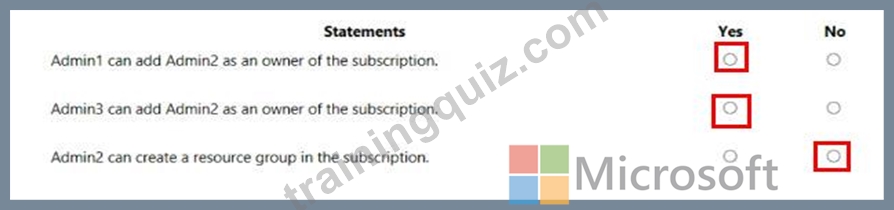
Explanation
They are all Global admins so they can all modify user permission. i.e add self as owner etc.
You can be GA in one of the subscription, it doesn't mean that you can create the resources in all subscription. As a Global Administrator in Azure Active Directory (Azure AD), you might not have access to all subscriptions and management groups in your directory. Azure AD and Azure resources are secured independently from one another. That is, Azure AD role assignments do not grant access to Azure resources, and Azure role assignments do not grant access to Azure AD.
However, if you are a Global Administrator in Azure AD, you can assign yourself access to all Azure subscriptions and management groups in your directory Reference:
https://docs.microsoft.com/en-gb/azure/role-based-access-control/elevate-access-global-admin
NEW QUESTION # 52
You have an Azure subscription that contains three virtual networks named VNET1, VNET2, and VNET3.
Peering for VNET1 is configured as shown in the following exhibit.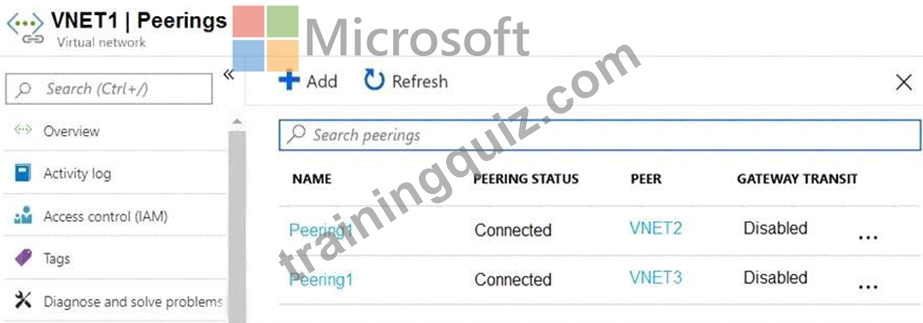
Peering for VNET2 is configured as shown in the following exhibit.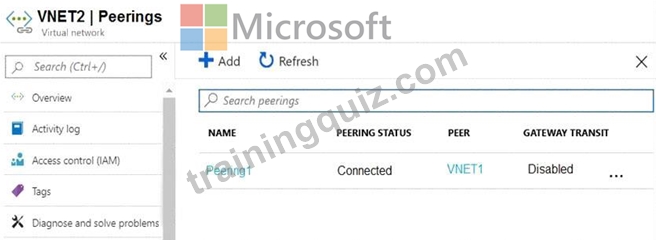
Peering for VNET3 is configured as shown in the following exhibit.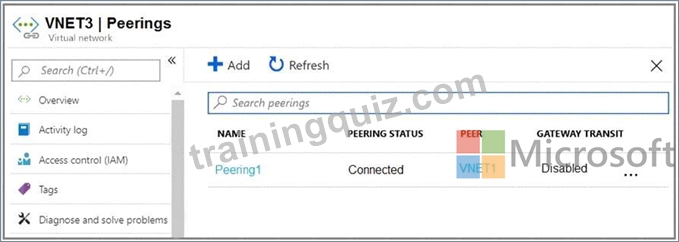
How can packets be routed between the virtual networks? To answer, select the appropriate options in the answer area.
NOTE: Each correct selection is worth one point.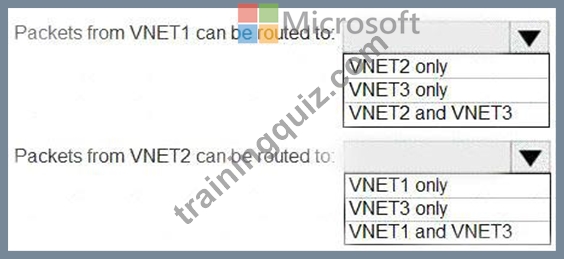
Answer:
Explanation: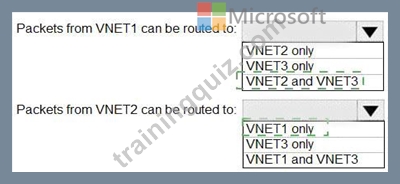
Explanation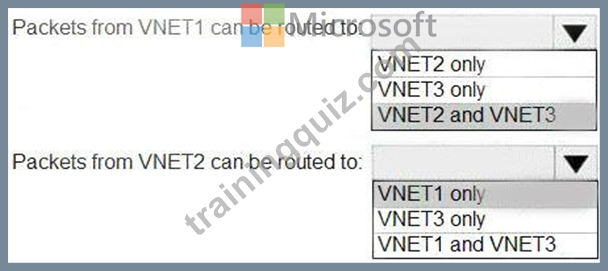
Box 1. VNET2 and VNET3
Box 2: VNET1
Gateway transit is disabled.
Reference:
https://docs.microsoft.com/en-us/azure/virtual-network/virtual-network-peering-overview
NEW QUESTION # 53
You have an Azure subscription that contains a virtual machine named VM1. VM1 hosts a line-of-business application that is available 24 hours a day. VM1 has one network interface and one managed disk. VM1 uses the D4s v3 size.
You plan to make the following changes to VM1:
* Change the size to D8s v3.
* Add a 500-GB managed disk.
* Add the Puppet Agent extension.
* Enable Desired State Configuration Management.
Which change will cause downtime for VM1?
- A. Add a 500-GB managed disk
- B. Enable Desired State Configuration Management
- C. Change the size to D8s v3
- D. Add the Puppet Agent extension
Answer: C
Explanation:
While resizing the VM it must be in a stopped state.
Reference:
https://azure.microsoft.com/en-us/blog/resize-virtual-machines/
NEW QUESTION # 54
You have the role assignment file shown in the following exhibit.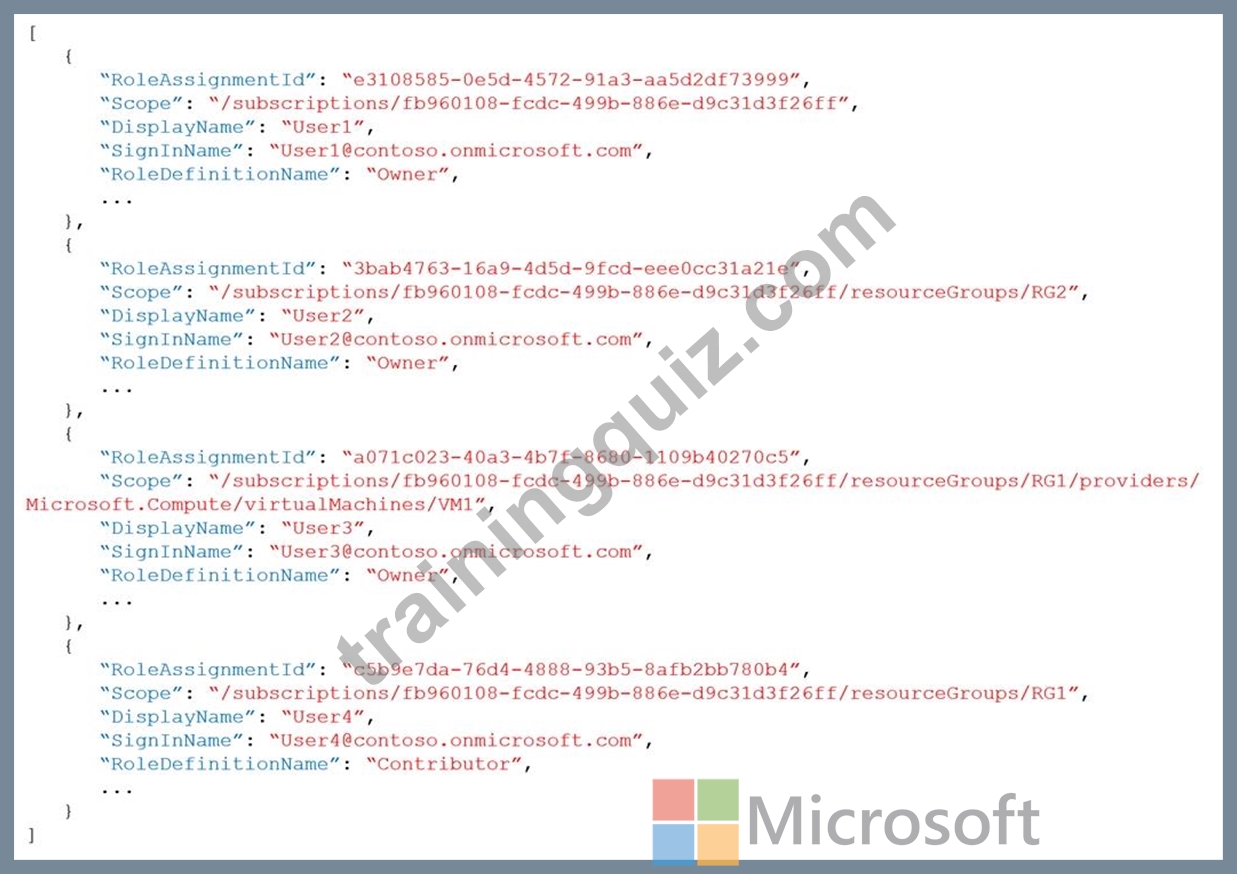
Use the drop-down menus to select the answer choice that completes
Use the drop-down menus to select the answer choice that completes each statement based on the information presented in the graphic.
NOTE: Each correct selection is worm one point.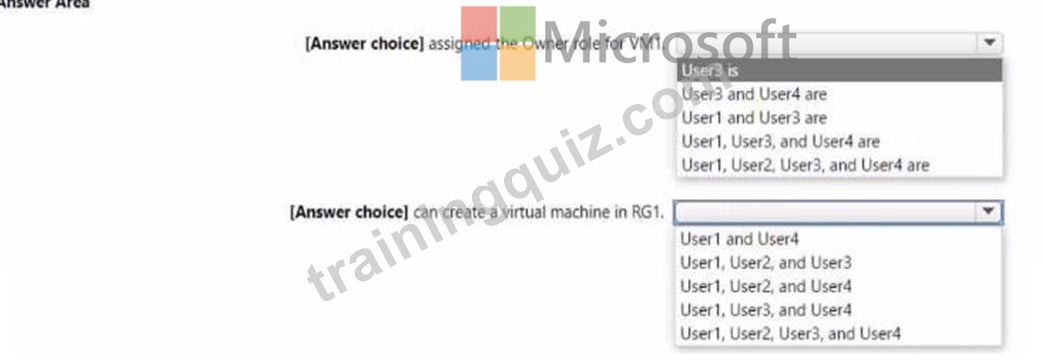
Answer:
Explanation: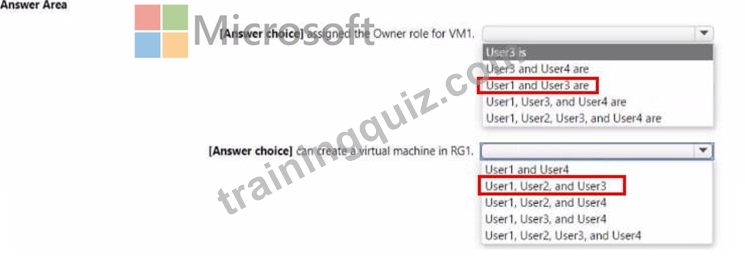
NEW QUESTION # 55
You have an Azure subscription that contains the resource groups shown in the following table.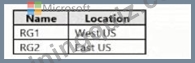
RG1 contains the resources shown in the following table.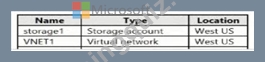
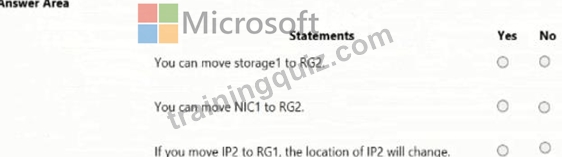
Answer:
Explanation: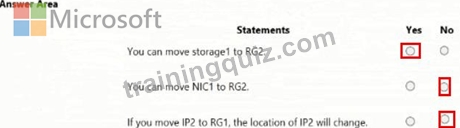
NEW QUESTION # 56
Drag and Drop Question
You have an Azure Linux virtual machine that is protected by Azure Backup.
One week ago, two files were deleted from the virtual machine.
You need to restore the deleted files to an on-premises Windows Server 2016 computer as quickly as possible.
Which four actions should you perform in sequence? To answer, move the appropriate actions from the list of actions to the answer area and arrange them in the correct order.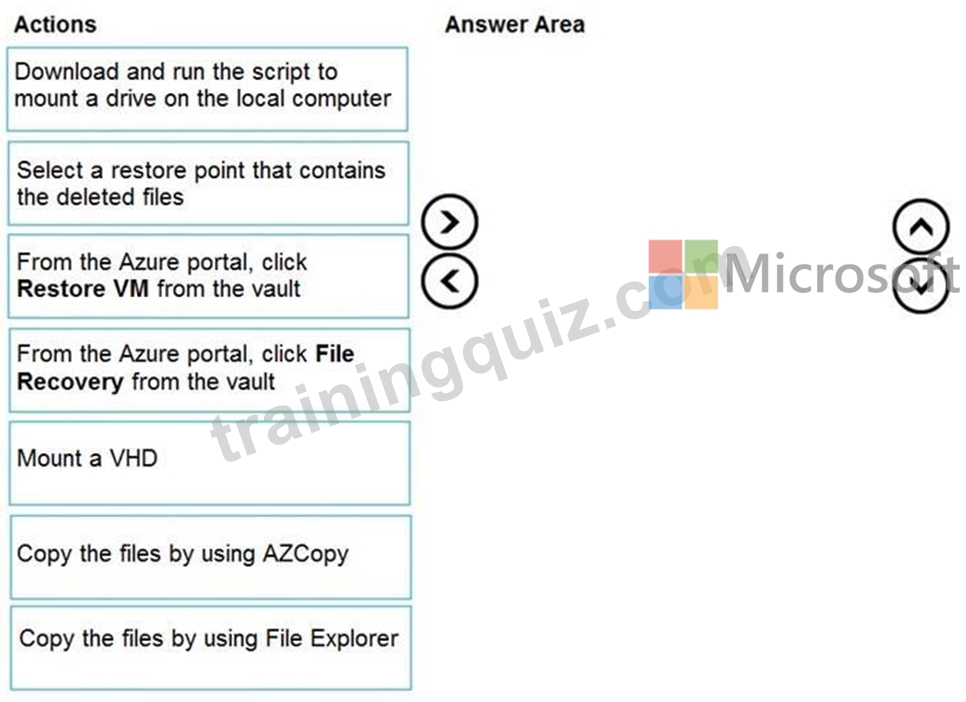
Answer:
Explanation: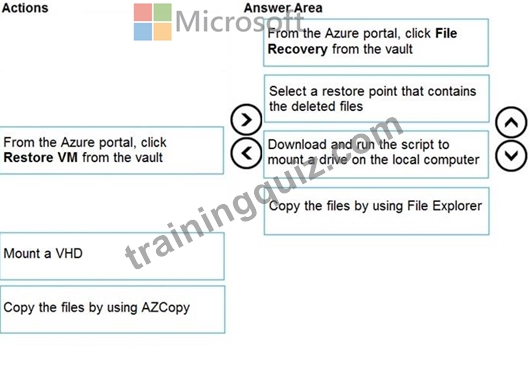
Explanation:
Step 1: From the Azure portal, click File Recovery from the vault
Step 2. Select a restore point that contains the deleted files
Step 3: Download and run the script to mount a drive on the local computer Generate and download script to browse and recover files:
Step 4: Copy the files using File Explorer!
After the disks are attached, use Windows File Explorer to browse the new volumes and files.
The restore files functionality provides access to all files in a recovery point. Manage the files via File Explorer as you would for normal files.
Step 1-3 below:
To restore files or folders from the recovery point, go to the virtual machine and perform the following steps:
1. Sign in to the Azure portal and in the left pane, select Virtual machines. From the list of virtual machines, select the virtual machine to open that virtual machine's dashboard.
2. In the virtual machine's menu, select Backup to open the Backup dashboard.
3. In the Backup dashboard menu, select File Recovery.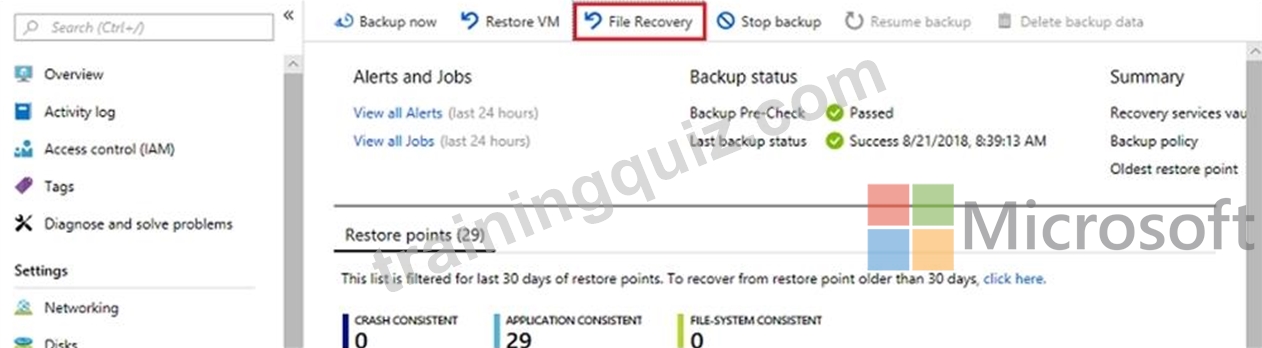
The File Recovery menu opens.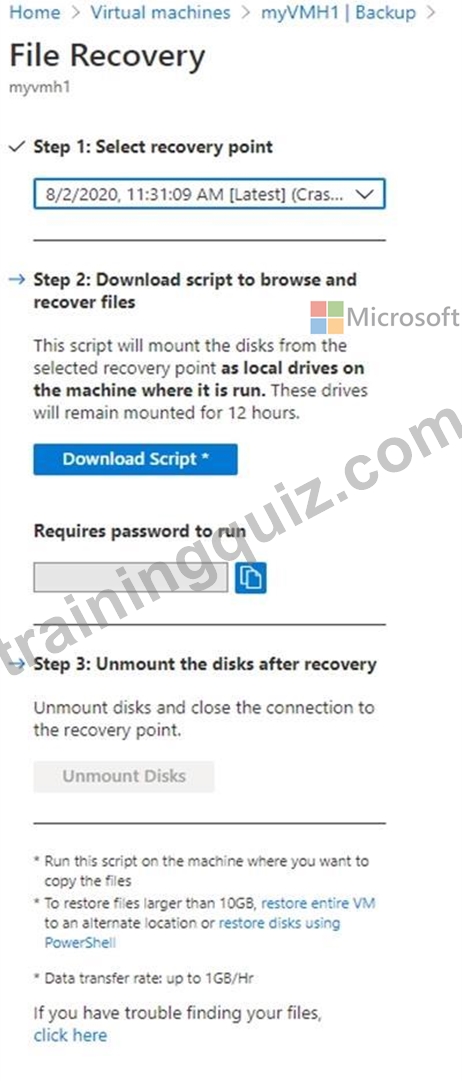
4. From the Select recovery point drop-down menu, select the recovery point that holds the files you want. By default, the latest recovery point is already selected.
5. Select Download Executable (for Windows Azure VMs) or Download Script (for Linux Azure VMs, a python script is generated) to download the software used to copy files from the recovery point.
Running the script and identifying volumes:
For Linux machines, a python script is generated. Download the script and copy it to the relevant/compatible Linux server.
Reference:
https://docs.microsoft.com/en-us/azure/backup/backup-azure-restore-files-from-vm
https://docs.microsoft.com/en-us/azure/backup/backup-azure-vms-automation#restore-files-from- an-azure-vm-backup
NEW QUESTION # 57
Case Study 6 - ADatum Corporation
Overview
ADatum Corporation is consulting firm that has a main office in Montreal and branch offices in Seattle and New York.
Existing Environment
Azure Environment
ADatum has an Azure subscription that contains three resource groups named RG1, RG2, and RG3.
The subscription contains the storage accounts shown in the following table.
The subscription contains the virtual machines shown in the following table.
The subscription has an Azure container registry that contains the images shown in the following table.
The subscription contains the resources shown in the following table.
Azure Key Vault
The subscription contains an Azure key vault named Vault1.
Vault1 contains the certificates shown in the following table.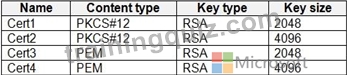
Vault1 contains the keys shown in the following table.
Microsoft Entra Environment
ADatum has a Microsoft Entra tenant named adatum.com that is linked to the Azure subscription and contains the users shown in the following table.
The tenant contains the groups shown in the following table.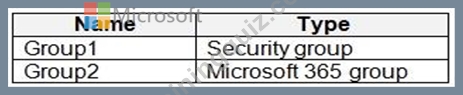
The adatum.com tenant has a custom security attribute named Attribute1.
Planned Changes
ADatum plans to implement the following changes:
- Configure a data collection rule (DCR) named DCR1 to collect only system events that have an event ID of 4648 from VM2 and VM4.
- In storage1, create a new container named cont2 that has the following access policies:
o Three stored access policies named Stored1, Stored2, and Stored3
o A legal hold for immutable blob storage
- Whenever possible, use directories to organize storage account content.
- Grant User1 the permissions required to link Zone1 to VNet1.
- Assign Attribute1 to supported adatum.com resources.
- In storage2, create an encryption scope named Scope1.
- Deploy new containers by using Image1 or Image2.
Technical Requirements
ADatum must meet the following technical requirements:
- Use TLS for WebApp1.
- Follow the principle of least privilege.
- Grant permissions at the required scope only.
- Ensure that Scope1 is used to encrypt storage services.
- Use Azure Backup to back up cont1 and share1 as frequently as possible.
- Whenever possible, use Azure Disk Encryption and a key encryption key (KEK) to encrypt the virtual machines.
Hotspot Question
You need to implement the planned change for Attribute1.
For each of the following statements, select Yes if the statement is true. Otherwise, select No.
NOTE: Each correct selection is worth one point.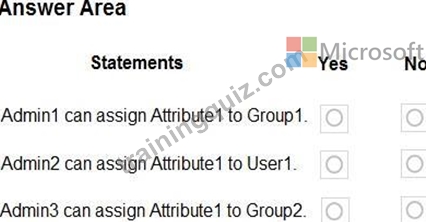
Answer:
Explanation: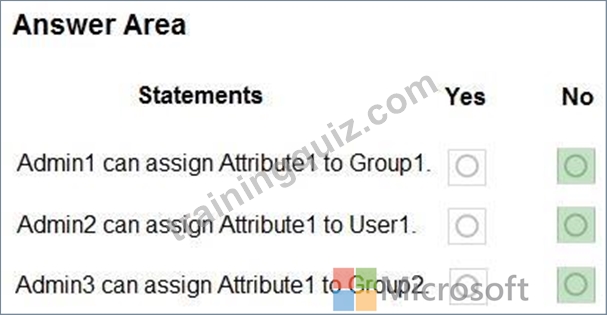
NEW QUESTION # 58
You have Azure subscriptions named Subscription1 and Subscription2.
Subscription1 has following resource groups:
RG1 includes a web app named App1 in the West Europe location.
Subscription2 contains the following resource groups:
For each of the following statements, select Yes if the statement is true. Otherwise, select No.
NOTE: Each correct selection is worth one point.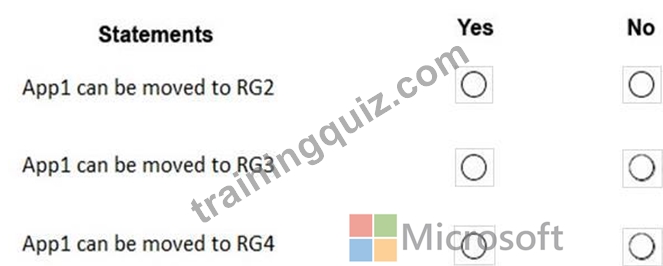
Answer:
Explanation: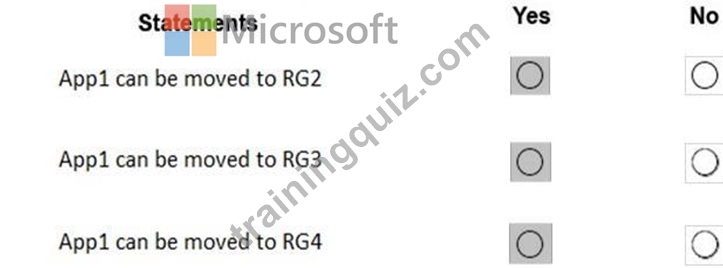
App1 present in RG1 and in RG1 there is no lock available. So you can move App1 to other resource groups, RG2, RG3, RG4.
Note:
App Service resources can only be moved from the resource group in which they were originally created. If an App Service resource is no longer in its original resource group, move it back to its original resource group.
Reference:
https://docs.microsoft.com/en-us/azure/azure-resource-manager/management/move-limitations/app-service-move
NEW QUESTION # 59
......
AZ-104 Exam Dumps, AZ-104 Practice Test Questions: https://www.trainingquiz.com/AZ-104-practice-quiz.html
Free AZ-104 Exam Dumps to Pass Exam Easily: https://drive.google.com/open?id=1DBoPVeU9Z3gS7IQGLIbUsdaLLE3bOzO0
